








zprávy
zdroje zpráv:Earth from Space: Tromsø
20.12.2019 10:10 ESA Observing the Earth Video:
00:02:34
Video:
00:02:34
This week's edition of the Earth from Space programme features a Copernicus Sentinel-2 image over Tromsø – the largest city in northern Norway.
See also Tromsø, Norway to download the image.
Tromsø, Norway
20.12.2019 10:00 ESA Observing the Earth Image:
With Christmas almost here, the red and white of this Copernicus Sentinel-2 image bring a festive feel to this week’s image featuring Tromsø – the largest city in northern Norway.
This false-colour image was processed in a way that included the near-infrared channel, which makes vegetation appear bright red. The snow over the surrounding mountains is visible in white, adding to the Christmassy feel of the image.
Most of Tromsø, lies on the island of Tromsøya, visible at the top of the image. Owing to its northerly location, the city is a popular area to experience the majestic phenomenon of the aurora borealis, or northern lights.
Tromsø is over 300 km north of the Arctic Circle. During the winter, it’s shrouded in darkness – the Sun sets in late-November and doesn’t rise again until January. The image was captured on 15 October 2019, which means it is one of the last images that Sentinel-2 could acquire before darkness descended.
During the long winter months, the Copernicus Sentinel-1 mission is used to monitor this region instead of Sentinel-2. As an advanced radar mission, Copernicus Sentinel-1 can image the surface of Earth through cloud and rain and regardless of whether it is day or night.
In September 2019, the German research icebreaker Polarstern left from Tromsø for a mammoth Arctic expedition. The Multidisciplinary drifting Observatory for the Study of Arctic Climate (MOSAiC) expedition involves the icebreaker spending a year drifting in the Arctic sea ice.
Spearheaded by the Alfred Wegener Institute (AWI), MOSAiC is the biggest shipborne polar expedition of all time. The data gathered during the expedition will be used by scientists around the world to study the Arctic as the epicentre of global warming and gain fundamental insights that are key to better understand global climate change.
This image is also featured on the Earth from Space video programme.
provozní doba Vánoce
20.12.2019 9:51 ČÚZK /Urady/Katastralni-urady/Katastralni-urady/Katastralni-urad-pro-Olomoucky-kraj/O-uradu/Aktuality/provozni-doba-Vanoceprovozní doba Vánoce
20.12.2019 9:51 ČÚZK - předpisy a opatření Katastrální úřad pro Olomoucký kraj provozní doba Vánoce Dovolujeme si upozornit, že v úterý dne 31. 12. 2019 bude Katastrální úřad pro Olomoucký kraj včetně katastrálních pracovišťotevřen pro veřejnost pouze v době od 8:00 do 12:00 hodin.
V ostatní dny jsou úřední hodiny beze změn.
Dále upozorňujeme, že ve dnech 27. 12., 30. 12. a 31. 12. 2019 nebude možná úhrada správních poplatků v hotovosti.
Správní poplatek bude možné uhradit platební kartou nebo bezhotovostním převodem.
Děkujeme za pochopení a přejeme klientům příjemné prožití vánočních svátků.
Ing. Daniel Janošík
ředitel úřadu
Instrument flying supported by EGNOS for General Aviation
20.12.2019 9:49 European GNSS Agency
Even though the General Aviation (GA) community undertakes millions of flights on aircraft equipped with GNSS-receivers, it is not taking full advantage of the technology. It is a priority of the European GNSS Agency (GSA) to support GA by facilitating instrument procedures with EGNOS. As a first step the GSA has identified enablers and blocking points along with aviation stakeholders and the European Aviation Safety Agency (EASA).
There are currently 660 EGNOS procedures in Europe, most of which are at instrument runways. However, EGNOS can also support general and business aviation on non-instrument runways. The GSA has issued safety promotion material on GNSS-based Instrument Flight Procedures implementation for General Aviation, Uncontrolled Aerodromes and Non-Instrument Runways in an effort to address this and encourage a wider use of EGNOS in general aviation.
The materials draw together the current regulatory analysis supporting EGNOS operations, along with enablers and best practices to support implementation, open issues and, last but not least, use case examples to encourage national authorities to authorise these types of operations in their countries. This includes examples showcasing how these can be implemented at locations where there are currently visual flight rules only.
Read this: EGNSS enabling change in General Aviation
High engagement
This document is aligned with the EASA Roadmap for General Aviation, which identifies simpler, more proportional rules and operations that are cost efficient, flexible and based on existing best practices. It aims to provide a view on the current implementation enablers in different EU countries and highlights the results of EASA RMTs (Rule Making Tasks) which can be relevant for the implementation of IFR for General Aviation.
“The General Aviation community undertakes millions of flights with aircraft equipped with GNSS-receivers without using the full capabilities of this new technology. By developing IFR procedures for situations where the ground infrastructure may not be present at the aerodrome it would enable GA pilots to plan A-to-B flights with more confidence of being able to complete them safely in changing weather conditions, which would have a positive impact on safety. EASA is extremely grateful to EGA for this collaborative effort,” said Dominique Roland, Head of General Aviation & Remotely Piloted Aircraft Systems at EASA.
The document will be of interest to General Aviation community, aerodromes, and air traffic control staff and national authorities alike. Publication of this document aims to start a discussion within the General aviation community, trigger future pilot cases and obtain feedback to identify the tools that should be developed to support the implementation of the IFR procedures for general aviation.
“Engagement from the aviation community has been high - we received more than 320 comments from over 25 contributors, including civil aviation authorities, air navigation service providers and others during preparation of the document. The GSA would like to thank all the contributors and supporters of this initiative, as this support was fundamental to the development of the document,” said GSA head of Market Development department Fiammetta Diani. “Special thanks go to EASA, ESSP, PPL IR, AOPA, EBAA, Austro Control, DFS, IDRF, FOCA Swiss, the Swedish Transport Agency, Europe Air Sports and the European Regional Aerodromes Community,” she said.
Just the beginning
The document will be published as a Safety Promotion material under EASA’s Together4Safety Safety Promotion initiative. This initiative is a key enabler towards reaching the ultimate objectives of the EU Aviation Safety Management Strategy and contributes to the continuous improvement of aviation safety in Europe and worldwide, together with regulations and oversight.
And this: Austro Control and EGNOS – a story of success
Publication of the materials is just the beginning. The GSA is launching a network of pilot cases in 2020 to collect lessons learned and best practices to promote and support future implementation. It is also proof that GNSS/SBAS is ready to support many different types of operations, extending beyond the traditional scope or initial objectives that the technology was designed for. If you would like to be among first to implement LPV at a non-instrument runway, you are more than welcome!
Media note: This feature can be republished without charge provided the European GNSS Agency (GSA) is acknowledged as the source at the top or the bottom of the story. You must request permission before you use any of the photographs on the site. If you republish, we would be grateful if you could link back to the GSA website (http://www.gsa.europa.eu).
Veřejná konzultace k datovým sadám s vysokou hodnotou (pozvánka)
20.12.2019 8:13 GISportal.cz
Ministerstvo vnitra ČR zve na veřejnou konzultaci. Zapojte se do sběru návrhů datových sad s vysokou hodnotou v šesti kategoriích (geoprostorové údaje, pozorování Země a životní prostředí, meteorologie, statistika, společnosti a vlastnictví společností, mobilita), které budou povinně publikovány jako otevřená data napříč všemi členskými zeměmi EU jakožto součást nově schválené směrnice o otevřených datech. Pravděpodobně […]
The post Veřejná konzultace k datovým sadám s vysokou hodnotou (pozvánka) appeared first on GISportal.cz.
Sdělení
20.12.2019 8:04 ČÚZK - předpisy a opatření Český úřad zeměměřický a katastrální zveřejnil novou aktualitu: Vážení klienti,úřední hodiny na Zeměměřickém
a katastrálním inspektorátu v Opavě
budou v prosinci 2019 upraveny
z provozních důvodů následovně:
- pondělí 23. 12. 2019:
8.00 - 14.00 hod.
- pondělí 30. 12. 2019:
8.00 - 14.00 hod.
Děkujeme za pochopení.
Sdělení
20.12.2019 8:04 ČÚZK /Urady/Zememericke-a-katastralni-inspektoraty/Zememericke-a-katastralni-inspektoraty/Zememericky-a-katastralni-inspektorat-v-Opave/O-uradu/Aktuality/SdeleniFirmy, ozvěte se. Ministerstvo chce vědět, jaké datové sady byste chtěly
20.12.2019 7:48 ZeměměřičMinisterstvo vnitra oznámilo veřejnou konzultaci k datovým sadám s vysokou hodnotou. Martin Nečaský k ní zve na webu ministerstva. Zapojte se do sběru návrhů datových sad s vysokou hodnotou v šesti kategoriích (geoprostorové údaje, pozorování Země a životní prostředí, meteorologie, statistika, společnosti a vlastnictví společností, mobilita), které budou povinně publikovány jako otevřená data napříč všemi členskými zeměmi EU jakožto součást nově schválené […]
The post Firmy, ozvěte se. Ministerstvo chce vědět, jaké datové sady byste chtěly appeared first on Zeměměřič.
Prohlížecí služba Esri ArcGIS Server - Podkladová vektorová mapa ČR
20.12.2019 1:00 Cenia - Katalog metadat ČR - INSPIRE Prohlížecí služba AGS - Podkladová vektorová mapa ČR je poskytována jako veřejná dynamická vektorová prohlížecí služba nad vybranými objekty ZABAGED® a DATA50. Služba může být využita jako vektorová podkladová mapa ČR pro souvislou měřítkovou řadu, tj. pro měřítka od cca 1:1 000 000 do cca 1:1 000.Jedná se o prohlížecí službu poskytovanou technologií Esri ArcGIS Server. Službu lze využít prostřednictvím rozhraní REST, SOAP nebo jako WMS službu.INSPIRE téma Budovy (BU)
20.12.2019 1:00 Cenia - Katalog metadat ČR - INSPIRE Data odpovídají směrnici INSPIRE pro téma budovy (BU). Data pochází částečně z projektu RÚIAN (Registr územní identifikace, adres a nemovitostí), který je součástí základních registrů České Republiky a obsahuje informace o územní identifikaci, adresách a nemovitostech, a částečně z ISKN (Informační systém katastru nemovistostí). Zdrojem informací o budovách v ISKN je objekt Stavba, v RÚIAN je to Stavební objekt. Většina Staveb je zároveň Stavebními objekty, ale jsou případy, kdy tomu tak není. Kromě Budov datová sada obsahuje i části budov, které jsou pro potřeby INSPIRE vyjádřeny vchody z RÚIAN. Vchody obsahují informace o počtu podlaží, technickoekonomických atributech apod. Datová sada pokrývá celé území české republiky. V datové sadě není uvedeno 1,15%, t.j. 48586 budov (k 16. 12. 2019), protože neobsahují definiční bod ani polygon. Více v zákoně č. 111/2009 Sb., o základních registrech, ve vyhlášce č. 359/2011 Sb., o základním registru územní identifikace, adres a nemovitostí v platných zněních, v zákoně 256/2013 Sb., o katastru nemovitostí, v katastrální vyhlášce č. 357/2013 Sb. v platném znění a INSPIRE Data Specification on Buildings v 3.0 z 13.12.2013. Data ve formátu GML 3.2.1 jsou validní proti schématu XML pro INSPIRE téma Budovy ve verzi 4.0 a proti schématu pro prostorová data ELF ve verzi 1.0.Prohlížecí služba WMS - Podkladová vektorová mapa ČR
20.12.2019 1:00 Cenia - Katalog metadat ČR - INSPIRE Prohlížecí služba WMS - Podkladová vektorová mapa ČR je poskytována jako veřejná dynamická vektorová prohlížecí služba nad vybranými objekty ZABAGED® a DATA50. Služba může být využita jako vektorová podkladová mapa ČR pro souvislou měřítkovou řadu, tj. pro měřítka od cca 1:1 000 000 do cca 1:1 000.INSPIRE téma Adresy (AD)
20.12.2019 1:00 Cenia - Katalog metadat ČR - INSPIRE Data odpovídají směrnici INSPIRE pro téma adresy (AD). Vychází především z projektu RÚIAN (Registr územní identifikace, adres a nemovitostí), který je součástí základních registrů České Republiky a obsahuje informace o územní identifikaci, adresách a nemovitostech. Data publikovaná v rámci INSPIRE obsahují pouze adresní místa a jejich komponenty, kterými jsou stát, obec, část obce, městský obvod v Praze (MOP), městký obvod/městská část (MO/MČ), ulice a pošta a to na území celé České Republiky. Obsahují rozvněž geometrii, která určuje definiční bod adresního místa. V datové sadě nění uvedeno 1,26%, t.j. 37019 adresních míst (k 16. 12. 2019), protože neobsahují definiční bod, podle kterého by je bylo možné prostorově určit. Více v zákoně č. 111/2009 Sb., o základních registrech a ve vyhlášce č. 359/2011 Sb., o základním registru územní identifikace, adres a nemovitostí v platných zněních a INSPIRE Data Specification on Addresses v 3.0.1 z 26.4.2010. Data ve formátu GML 3.2.1 jsou validní proti schématu XML pro INSPIRE téma Adresy ve verzi 4.0 a proti schématu pro prostorová data ELF ve verzi 1.0.INSPIRE služba transformace souřadnic WCTS
20.12.2019 1:00 Cenia - Katalog metadat ČR - INSPIRE INSPIRE služba transformace souřadnic WCTS je on-line služba, která umožňuje převádět digitální geoprostorová data mezi souřadnicovými referenčními systémy S-JTSK, S-JTSK/05, ETRS89 a WGS84, včetně transformace výšek mezi systémy ETRS89 (GRS80), Bpv a WGS 84. Zároveň služba umožňuje transformace mezi souřadnicovými referenčními systémy stanovenými směrnicí INSPIRE: ETRS89-LAEA, ETRS89-LCC, ETRS89-TM33 a ETRS89-TM34, a to včetně transformace výšek v systému EVRS. Dále služba umožňuje transformace mezi souřadnicovými referenčními systémy WGS 84 / UTM 33, WGS 84 / UTM 34 a WGS 84 / Pseudo-Mercator. Služba využívá výpočetní modul programu ETJTZU 2019 verze 2019-10-01 schválený ČÚZK pro transformaci mezi ETRS89 a S-JTSK pomocí zpřesněné globální transformace použitelné pro data získaná pomocí GNSS v období od 1. 1. 2018. Střední polohová chyba transformace mezi systémy S-JTSK a ETRS89 (ETRF2000) při použití služby dosahuje hodnoty mp = 0.036 m na území ČR. Střední polohová chyba transformace mezi systémy ETRS89 (ETRF2000) a WGS 84 (G873) při použití služby dosahuje hodnoty mp = 0.040 m na území ČR. Poskytované operace jsou uvedeny ve vlastnostech služby (GetCapabilities). Službu je možné použít samostatně nebo jako součást dalších služeb a aplikací. Zájemcům o přepočty souřadnic je na stránkách Geoportálu ČÚZK zpřístupněn klient služby - aplikace Transformace souřadnic. Služba splňuje technické pokyny pro INSPIRE služby transformace souřadnic v. 2.1 a zároveň splňuje standard OGC WCTS 0.4.0.INSPIRE téma Parcely (CP)
20.12.2019 1:00 Cenia - Katalog metadat ČR - INSPIRE Data odpovídají směrnici INSPIRE pro téma katastrální parcely (CP). Vychází z katastrální mapy, která je závazným státním mapovým dílem velkého měřítka, obsahuje body polohového bodového pole, polohopis a popis a může mít formu digitální mapy, analogové mapy nebo digitalizované mapy. Data publikovaná v rámci INSPIRE obsahují pouze katastrální území (pro celou Českou Republiku) a parcely a jejich hranice z území, kde je digitální mapa (k 16. 12. 2019 je to 96,67% území České republiky, t.j. 76 243,11km2). Více katastrální zákon 344/1992 SB., katastrální vyhláška č.26/2007 Sb. v platném znění a INSPIRE Data Specification on Cadastral Parcels v 3.0.1. Data ve formátu GML 3.2.1 jsou validní proti schématu XML pro INSPIRE téma Parcely ve verzi 4.0 a proti schématu pro prostorová data ELF ve verzi 1.0.Katastrální mapa v rastrové podobě poskytovaná v e-shopu
20.12.2019 1:00 Cenia - Katalog metadat ČR - INSPIRE Katastrální mapa v rastrové podobě je poskytována za úplatu a obsahuje analogovou mapu s kompletní kresbou. Analogová mapa pokrývá 3,14 % území České republiky, což je 2 478,09km2. Více katastrální vyhláška č.357/2013 Sb. v platném znění.Katastrální mapa ve formátech DGN a DXF poskytovaná v e-shopu
20.12.2019 1:00 Cenia - Katalog metadat ČR - INSPIRE Katastrální mapa je závazným státním mapovým dílem velkého měřítka, obsahuje body polohového bodového pole, polohopis a popis. Katastrální mapa ve vektorové podobě je poskytována zdarma ve formátu DGN a DXF a obsahuje prvky Digitální katastrální mapy (DKM) a Katastrální mapy digitalizované (KMD), tedy bodová pole, budovy, další prvky mapy, hranice parcel, katastrální hranice, parcely katastru nemovitostí, prvky orientační mapy a hranice věcného břemene. Z důvodu použití formátu DGN produkt neobsahuje značky na liniích a oblouky jsou nahrazeny lomenými čárami. Katastrální mapa ve vektorové podobě k 16. 12. 2019 pokrývá 96,67% území České republiky, t.j. 76 243,11km2. Více katastrální vyhláška č.357/2013 Sb. v platném znění.INSPIRE téma Rozšířené Parcely (CPX)
20.12.2019 1:00 Cenia - Katalog metadat ČR - INSPIRE Rozšíření má za cíl poskytovat katastrální mapu s obsahem podle vyhlášky ve vektorové podobě ve struktuře plně v souladu se strukturou danou směrnicí INSPIRE. Data rozšiřují směrnici INSPIRE pro téma katastrální parcely (CP) o věcná břemena, geodetické body, další prvky mapy, původní obloukovou geometrii a o parcely určené definičním bodem (ty pouze v oblastech s analogovou mapou). Vychází z katastrální mapy, která je závazným státním mapovým dílem velkého měřítka, obsahuje body polohového bodového pole, polohopis a popis a může mít formu digitální mapy, analogové mapy nebo digitalizované mapy. Publikovaná data obsahují katastrální území pro celou Českou Republiku, parcely a jejich hranice, věcná břemena, další prvky mapy a původní obloukovou geometrii z území, kde je digitální mapa (k 16. 12. 2019 je to 96,67% území České republiky, t.j. 76 243,11km2) a ve zbytku území katastrální parcely určené pouze definičním bodem (tedy bez hranic a polygonu). Katastrální parcely a hranice obsahují oproti datové sadě INSPIRE některé atributy navíc. Jedná se o typ hranice, způsob využití území, druh pozemku, vazbu na budovu a o mapové značky. Více katastrální zákon 344/1992 SB., katastrální vyhláška č.26/2007 Sb. v platném znění a INSPIRE Data Specification on Cadastral Parcels v 3.0.1. Data ve formátu GML 3.2.1 jsou validní proti schématu XML pro Rozšířené Parcely (CPX) ve verzi 4.0.Nabídka studijních pobytů v Číně
20.12.2019 0:00 Geografický ústav MUČína poskytuje stipendijní místa na semestrální studijní pobyty pro studenty bakalářských, magisterských a doktorských studijních programů, přednostně studentům jiných než sinologických oborů, v celkovém rozsahu 90 měsíců. Seznam univerzit v ČLR, na něž je možné se hlásit, zveřejňuje China Scholarship Council na svých webových stránkách zde. Programy s oranžovou hvězdou jsou ve stipendijní nabídce zahrnuté. Stipendistům je hrazena mezinárodní doprava do místa pobytu a zpět.
Seznam požadovaných dokumentů se zobrazí po kliknutí na odkaz ČÍNA – výběrová řízení. Akceptační dopis z čínské univerzity není pro účely výběrového řízení povinný, nicméně úspěšní uchazeči budou posléze vyzváni k podání on-line přihlášky a předložení další dokumentace. Zájemci se přihlašují v termínu 20. prosince 2019 do 12:00 zasláním požadovaných dokumentů do sídla Akademické informační agentury (Dům zahraniční spolupráce, AIA, Na Poříčí 1035/4, 110 00 Praha 1).
Nabídka studijních pobytů v Číně
20.12.2019 0:00 Geografický ústav MUČína poskytuje stipendijní místa na semestrální studijní pobyty pro studenty bakalářských, magisterských a doktorských studijních programů, přednostně studentům jiných než sinologických oborů, v celkovém rozsahu 90 měsíců. Seznam univerzit v ČLR, na něž je možné se hlásit, zveřejňuje China Scholarship Council na svých webových stránkách zde. Programy s oranžovou hvězdou jsou ve stipendijní nabídce zahrnuté. Stipendistům je hrazena mezinárodní doprava do místa pobytu a zpět.
Seznam požadovaných dokumentů se zobrazí po kliknutí na odkaz ČÍNA – výběrová řízení. Akceptační dopis z čínské univerzity není pro účely výběrového řízení povinný, nicméně úspěšní uchazeči budou posléze vyzváni k podání on-line přihlášky a předložení další dokumentace. Zájemci se přihlašují v termínu 20. prosince 2019 do 12:00 zasláním požadovaných dokumentů do sídla Akademické informační agentury (Dům zahraniční spolupráce, AIA, Na Poříčí 1035/4, 110 00 Praha 1).
Florida NENA Selects DATAMARK for Statewide NG9-1-1 GIS Education
19.12.2019 20:18 GISCafe.com Webcasts-Webinars TALLAHASSEE, Fla., Dec. 19, 2019 (GLOBE NEWSWIRE) -- DATAMARK today announced that the Florida Chapter of the National Emergency Number Association …Flirtey begins routine drone delivery demonstrations in the largest industrial center in the United States
19.12.2019 20:18 GISCafe.com Webcasts-Webinars STOREY COUNTY, Nev., Dec. 19, 2019 — (PRNewswire) — Flirtey announced today it has begun routine drone delivery demonstrations in …What’s the Point of the End-of-Year Specials?
19.12.2019 18:11 Carlson Software When someone, maybe my neighbor or the clerk at the convenience store, says to me, “Happy New Year!” — my first thought is always, “Oh, man, it’s Carlson’s End of Year Special time again. I wonder what new tools I’ll get this year! I wonder what great new functionality I’ll have!” At the end of […]
SkyDrive Launches Test Flights of First-ever Cargo Drone That Will Boost Productivity in Hard-to-Reach Places
19.12.2019 16:19 GISCafe.com Webcasts-Webinars TOKYO, Dec. 19, 2019 — (PRNewswire) — SkyDrive Inc., a leading flying-car developer, has successfully launched test flights of a cargo …Quanergy Unveils Industry’s First Solid State LiDAR-Based Access Control and People Counter Products for Security and Smart Spaces Applications
19.12.2019 16:19 GISCafe.com Webcasts-Webinars LiDAR-based Flow Management platform enables a broad range of applications for smart spaces and security initiatives including end-to-end solutions …Simple procurement accelerates adoption of Mapbox live mapping in Candian government
19.12.2019 16:19 GISCafe.com Webcasts-Webinars Washington, DC, Dec. 19, 2019 (GLOBE NEWSWIRE) -- WASHINGTON DC – December 2019 Mapbox, the AI-driven live mapping platform, has been …Galileo and EGNOS: supporting effective disaster management
19.12.2019 15:03 European GNSS Agency
When an emergency or a disaster hits a city or region, the priorities are to care for the wounded, restore infrastructure, provide logistics and basic services, and then to restore livelihoods and reconstruct communities. European GNSS – Galileo and EGNOS – supports applications and the delivery of critical services during the four key phases of the disaster management life cycle: preparedness, response, recovery, and mitigation.
When it comes to effectively preparing for and managing the consequences of a disaster, it is important to have access to precise and up-to-date information. GNSS-based applications make a significant contribution during the preparation and mitigation phases of disaster management, supporting GNSS monitoring and early warning systems for disasters such as landslide or tsunami.
For the future, an EGNSS-based Emergency Warning Service is being considered as an additional service to support disaster management. The widespread use of Galileo receivers embedded in mobile phones means that the system can provide truly global early warnings and direct the civilian population in the event of an emergency.
Response and recovery
During the response and recovery phases of disaster management, rescue teams need guidance to use the routes that are still available to reach the affected areas. This requires detailed mapping and high accuracy navigation and positioning capabilities. High accuracy is especially needed under difficult circumstances that reduce visibility, such as fires, smoke or fog.
Watch this: EGNOS for Helicopter Emergency Medical Services (HEMS)
Here the upcoming Galileo High Accuracy Service (HAS) will make a difference, providing the accuracy needed to navigate drones and to enhance the navigation capability of search and rescue teams, while the Authenticated Open Service (OS-NMA) will provide additional robustness to the Galileo signals, foiling any attempt to disrupt rescue operations. EGNOS enabled PinS also increase access to helipads in poor visibility for Helicopter Emergency and Medical Services (HEMS).
Drones for disaster response
Responding to the need for an effective system for people location that can be used by disaster relief services in difficult terrain, the MOBNET project is designing a system to locate isolated victims in the event of natural or man-made disasters. The system also can help first responder services to find lost people in the mountains.
Read this: Integrating GNSS in UAVs for faster SAR
The MOBNET solution takes advantage of the ubiquity of mobile phones and the cost and performance gains of using drones in search and rescue operations, while leveraging the high-quality timing synchronisation capabilities provided by Galileo. Taking advantage of these three features, MOBNET uses digital cellular technologies to detect the presence of people, by locating their mobiles, and help rescuers in their search.
Synergies in space
Earth observation such as Copernicus is invaluable to detect fires or to map the extent of a disaster. Depending on the type of emergency, timely meteorological data from satellites and ground monitoring stations are also very useful in coping with the response.
EGNSS works along with Copernicus remote sensing and Earth observation to provide a comprehensive space-based approach to disaster management. Copernicus applications include short and long-term flood forecasting and a fire risk index, early warning alerts, insurance and rapid mapping of disaster areas during an emergency.
Communications links are also vital to coordinate and direct the rescue teams at a time when transportation infrastructure, including roads and bridges, may be severely damaged or impassable. Satellite communication allows the transfer of data when the usual communication infrastructures are disabled by the disaster event. Working in synergy, Copernicus, EGNSS and satellite communications provide the spatial awareness, connectivity and highly accurate positioning and navigation needed for an effective response.
More success stories
The GEO-VISION project (GNSS-driven EO and Verifiable Image and Sensor Integration for mission-critical Operational Networks) has developed the RAIDO and AGILE solutions to increase the situational awareness of emergency services and allow first responders to check the integrity of the GNSS signals they receive, increasing the efficiency of the emergency response and helping to save more lives.
Likewise, the AIOSAT (Autonomous Indoor & Outdoor Safety Tracking System) project is developing a portable system that can be carried by first responders operating in a disaster zone. This system continuously transmits the position of the responders to a Mobile Coordination Centre, allowing them to effectively manage the situation and prevent rescue workers from taking risky actions.
In this way, the application counteracts some of the issues that arise with GNSS use in an emergency situation, such as a fire for example, where GNSS availability, reliability, and accuracy can be affected by the thick smoke, dense forests, rough terrain or the fact that responders are inside buildings.
Media note: This feature can be republished without charge provided the European GNSS Agency (GSA) is acknowledged as the source at the top or the bottom of the story. You must request permission before you use any of the photographs on the site. If you republish, we would be grateful if you could link back to the GSA website (http://www.gsa.europa.eu).
EGNSS and agriculture – a win-win relationship
19.12.2019 11:32 European GNSS Agency
GNSS is a key enabler of precision agriculture, allowing farmers to drive their tractors along parallel lines, avoid overlaps and gaps in field cultivation, and reduce their fatigue thanks to satellite-enabled autopilot. GNSS also helps to reduce agriculture’s ecological footprint – a win-win situation for society as a whole. Thanks to Galileo´s dual frequency and authentication capability, it can also help farmers and authorities in the frame of the Common Agricultural Policy (CAP).
Speaking at the EGNSS4CAP Workshop, a part of the 25th JRC MARS Conference in Prague on 29 November, European GNSS Agency Executive Director Carlo des Dorides said that for 10 years already EGNOS had been providing farmers with an affordable precision agriculture entry solution, delivering metre-level accuracy over Europe free of charge.
He noted that equipment manufacturers had been quick to realize the benefits of EGNOS, and that over 90% of new tractors in Europe are currently equipped with EGNOS receivers. “Galileo also offers several services that the agriculture community can benefit from – the Open Service is already improving positioning and navigation, especially thanks to dual frequency. It will be complemented by the High Accuracy Service that will provide around 20-cm accuracy free of charge and the Authentication Service that will reduce risks associated with spoofing,” des Dorides said.
Space synergies
On its own, GNSS provides considerable benefits to farmers, but it is when it works in synergy with the EU Earth observation programme Copernicus that the EU space programmes really deliver. “EGNSS and Copernicus are two pillars that play a crucial role in achieving sustainable agriculture,” des Dorides said. “In particular, the satellite programmes play a crucial role in the Common Agricultural Policy, delivering significant added-value for farmers, the institutions involved and society at large,” he said.
Read this: EU Space Week 2019: Sustainability and Space
One application that exploits synergies between EGNSS and Earth observation is EGNSS4CAP. This is an Android smartphone app that enables EU farmers to digitalise procedures related to their reporting requirements under the current and post-2020 CAP. The application will enable farmers to provide geo-tagged photos to support and complement a Copernicus-based monitoring approach to CAP. It uses the Galileo differentiators, Open Service Authentication and dual frequency, and can help authorities and farmers to reduce bureaucratic burden and duplications, as well as improve performance and reliability.
Implementing CAP
“GNSS and Copernicus are the core components in the digital farming ecosystem (Agriculture 4.0) and the main contributors to the modernised CAP,” Fiammetta Diani, the GSA’s Head of Market Development said at the conference.
For example, satellite-based monitoring procedures can reduce the need for On-The-Spot Checks (OTSC) for area-based CAP payments (EU subsidies related to the area and type of crop). The Galileo-based geo-tagged photo application provides the location and timing of the photo, leveraging Galileo’s dual-frequency and authentication features to provide higher accuracy and authentication for reporting to the paying agencies. The application is freely and openly available for any institution or company that would like to integrate it in their own solutions.
In this way, EGNSS is helping to support efficient operations in one of the key areas of the EU economy. The CAP impacts almost 10 million people working in agriculture and has a proposed budget of EUR 365 billion for 2021-2027, accounting for about one-third of the total EU budget.
Media note: This feature can be republished without charge provided the European GNSS Agency (GSA) is acknowledged as the source at the top or the bottom of the story. You must request permission before you use any of the photographs on the site. If you republish, we would be grateful if you could link back to the GSA website (http://www.gsa.europa.eu).

Drones take flight – on the wings of GNSS
19.12.2019 10:02 European GNSS Agency
The drone market is booming and is set to outstrip any other GNSS user base in aviation and open up new business opportunities for application developers, according to a White Paper on European Global Navigation Satellite Systems (EGNSS) for drones operations, produced by the European GNSS Agency (GSA).
In light of the upswing on the drone market, European drone service revenues are expected to nearly double from EUR 32 million in 2018 to approximately EUR 60 million by 2020 and are eventually forecast to reach EUR 150 million by 2023.
GNSS is not an option for drones anymore, but a necessary asset. GNSS is essential for the safe and reliable navigation of drones, and GNSS receivers are implemented on almost all new commercial drones as standard. With increasing demand for beyond visual line of sight (BVLOS) operations GNSS, possibly with various augmentations, is the most obvious choice of technology for navigation, although it is not the only one.
EGNSS for added accuracy
Given the additional accuracy that Galileo offers, it is no surprise that Galileo is already present in more than 30% of the receivers used for drone applications, and many of them also implement EGNOS corrections to increase accuracy. The GSA White paper provides an overview of the added value of EGNOS and Galileo for current and emerging operations, as well as for future U-Space services.
Read this: Targeting the development of a drone-borne Galileo receiver
The paper provides a market perspective of GNSS for drones, together with a summary of applications powered by EGNSS and the results of testing campaigns that show the benefits of EGNSS vs GPS in different operational contexts. With Galileo satellites in addition to GPS, drones can use signals from more satellites for position determination which improves their accuracy and also increases the availability of received signals. This is particularly important in urban canyons.
Galileo also offers distinct and unique features that benefit drone operations. For example, Galileo’s authentication will provide additional trust in the position, which is more robust against intentional or unintentional interferences. EGNOS corrections also provide improved robustness over Europe and higher safety of navigation as well as improved accuracy, which is especially relevant in the vertical axis for drones operations.
Seeking your input
The paper targets drone manufacturers and operators, but also entrepreneurs planning to offer new services with unmanned platforms. The document can serve as a basis to choose navigation solutions based on EGNOS/Galileo that will increase the robustness of their operations thanks to increased navigation performance.
And this: Performance Cockpit takes overall prize at Galileo Masters 2019
The document is intended to be a living document and we welcome contributions from operators and users who would like to share their experience of using EGNOS and Galileo. Likewise, if you have additional needs that you would like to be met by future evolutions of the EGNSS services, then we would love to hear from you.
Media note: This feature can be republished without charge provided the European GNSS Agency (GSA) is acknowledged as the source at the top or the bottom of the story. You must request permission before you use any of the photographs on the site. If you republish, we would be grateful if you could link back to the GSA website (http://www.gsa.europa.eu).
White Paper on EGNSS for drones now available
19.12.2019 10:02 European GNSS AgencyThe drone market is booming and is set to outstrip any other GNSS user base in aviation and open up new business opportunities for application developers, according to a White Paper on European Global Navigation Satellite Systems (EGNSS) for drones operations, produced by the European GNSS Agency (GSA).
In light of the upswing on the drone market, European drone service revenues are expected to nearly double from EUR 32 million in 2018 to approximately EUR 60 million by 2020 and are eventually forecast to reach EUR 150 million by 2023.
GNSS is not an option for drones anymore, but a necessary asset. GNSS is essential for the safe and reliable navigation of drones, and GNSS receivers are implemented on almost all new commercial drones as standard. With increasing demand for beyond visual line of sight (BVLOS) operations GNSS, possibly with various augmentations, is the most obvious choice of technology for navigation, although it is not the only one.
EGNSS for added accuracy
Given the additional accuracy that Galileo offers, it is no surprise that Galileo is already present in more than 30% of the receivers used for drone applications, and many of them also implement EGNOS corrections to increase accuracy. The GSA White paper provides an overview of the added value of EGNOS and Galileo for current and emerging operations, as well as for future U-Space services.
Read this: Targeting the development of a drone-borne Galileo receiver
The paper provides a market perspective of GNSS for drones, together with a summary of applications powered by EGNSS and the results of testing campaigns that show the benefits of EGNSS vs GPS in different operational contexts. With Galileo satellites in addition to GPS, drones can use signals from more satellites for position determination which improves their accuracy and also increases the availability of received signals. This is particularly important in urban canyons.
Galileo also offers distinct and unique features that benefit drone operations. For example, Galileo’s authentication will provide additional trust in the position, which is more robust against intentional or unintentional interferences. EGNOS corrections also provide improved robustness over Europe and higher safety of navigation as well as improved accuracy, which is especially relevant in the vertical axis for drones operations.
Seeking your input
The paper targets drone manufacturers and operators, but also entrepreneurs planning to offer new services with unmanned platforms. The document can serve as a basis to choose navigation solutions based on EGNOS/Galileo that will increase the robustness of their operations thanks to increased navigation performance.
And this: Performance Cockpit takes overall prize at Galileo Masters 2019
The document is intended to be a living document and we welcome contributions from operators and users who would like to share their experience of using EGNOS and Galileo. Likewise, if you have additional needs that you would like to be met by future evolutions of the EGNSS services, then we would love to hear from you.
Media note: This feature can be republished without charge provided the European GNSS Agency (GSA) is acknowledged as the source at the top or the bottom of the story. You must request permission before you use any of the photographs on the site. If you republish, we would be grateful if you could link back to the GSA website (http://www.gsa.europa.eu).
Drones take flight – on the wings of GNSS
19.12.2019 10:02 European GNSS AgencyThe drone market is booming and is set to outstrip any other GNSS user base in aviation and open up new business opportunities for application developers, according to a White Paper on European Global Navigation Satellite Systems (EGNSS) for drones operations, produced by the European GNSS Agency (GSA).
In light of the upswing on the drone market, European drone service revenues are expected to nearly double from EUR 32 million in 2018 to approximately EUR 60 million by 2020 and are eventually forecast to reach EUR 150 million by 2023.
GNSS is not an option for drones anymore, but a necessary asset. GNSS is essential for the safe and reliable navigation of drones, and GNSS receivers are implemented on almost all new commercial drones as standard. With increasing demand for beyond visual line of sight (BVLOS) operations GNSS, possibly with various augmentations, is the most obvious choice of technology for navigation, although it is not the only one.
EGNSS for added accuracy
Given the additional accuracy that Galileo offers, it is no surprise that Galileo is already present in more than 30% of the receivers used for drone applications, and many of them also implement EGNOS corrections to increase accuracy. The GSA White paper provides an overview of the added value of EGNOS and Galileo for current and emerging operations, as well as for future U-Space services.
Read this: Targeting the development of a drone-borne Galileo receiver
The paper provides a market perspective of GNSS for drones, together with a summary of applications powered by EGNSS and the results of testing campaigns that show the benefits of EGNSS vs GPS in different operational contexts. With Galileo satellites in addition to GPS, drones can use signals from more satellites for position determination which improves their accuracy and also increases the availability of received signals. This is particularly important in urban canyons.
Galileo also offers distinct and unique features that benefit drone operations. For example, Galileo’s authentication will provide additional trust in the position, which is more robust against intentional or unintentional interferences. EGNOS corrections also provide improved robustness over Europe and higher safety of navigation as well as improved accuracy, which is especially relevant in the vertical axis for drones operations.
Seeking your input
The paper targets drone manufacturers and operators, but also entrepreneurs planning to offer new services with unmanned platforms. The document can serve as a basis to choose navigation solutions based on EGNOS/Galileo that will increase the robustness of their operations thanks to increased navigation performance.
And this: Performance Cockpit takes overall prize at Galileo Masters 2019
The document is intended to be a living document and we welcome contributions from operators and users who would like to share their experience of using EGNOS and Galileo. Likewise, if you have additional needs that you would like to be met by future evolutions of the EGNSS services, then we would love to hear from you.
Media note: This feature can be republished without charge provided the European GNSS Agency (GSA) is acknowledged as the source at the top or the bottom of the story. You must request permission before you use any of the photographs on the site. If you republish, we would be grateful if you could link back to the GSA website (http://www.gsa.europa.eu).
WORLD OCEAN COUNCIL (WOC) MEMBERSHIP CONTINUES STRONG GROWTH IN 2019
19.12.2019 9:00 GISCafe.com Webcasts-Webinars A Diverse Range of Companies from Around the World and Across the Sectors This Year Joined the WOC - the Global Blue Economy Business and Investment …Brněnský seminář Družicové metody v geodézii a katastru
19.12.2019 7:35 ZeměměřičÚstav geodézie Fakulty stavební VUT v Brně zve na 23. ročník semináře „Družicové metody v geodézii a katastru“. Akce se koná ve čtvrtek 30. ledna 2020 v posluchárně D 182 Fakulty stavební VUT v Brně (Veveří 95, Brno). Odborným garantem programu semináře je doc. Ing. Josef Weigel, CSc. Program semináře je zaměřen především na družicová měření a jejich využití v praxi, problematiku permanentních a dalších […]
The post Brněnský seminář Družicové metody v geodézii a katastru appeared first on Zeměměřič.
Chemické složení podzemních vod Ašska a Chebska (Geoplasma-CE)
19.12.2019 1:00 Cenia - Katalog metadat ČR - INSPIRE ArcGIS Server služba zobrazuje chemické složení prostých i minerálních vod v oblasti Ašska a Chebska. Jednotlivé vrstvy zobrazují vybrané archivní vrty s hydrochemickými daty, chemické analýzy podzemních vod z objektů vzorkovaných v rámci projektu Geoplasma-CE, hydrochemické typy vod a nadlimitní obsahy některých složek dle vyhlášky č. 252/2004 Sb.Minerální vody Ašska a Chebska (Geoplasma-CE)
19.12.2019 1:00 Cenia - Katalog metadat ČR - INSPIRE ArcGIS Server služba zobrazuje místa výskytu minerálních vod a výronů CO2 v oblasti Ašska a Chebska a jejich typ. Pro vybrané vývěry a výrony jsou prezentovány popisy objektů, obsahy CO2 z terénních měření, celkové obsahy rozpuštěných látek, hydrochemické typy vod a fotodokumentace.Hydrogeologická mapa Ašska a Chebska (Geoplasma-CE)
19.12.2019 1:00 Cenia - Katalog metadat ČR - INSPIRE ArcGIS Server služba zobrazuje hydrogeologické jednotky v oblasti Ašska a Chebska s charakteristikou typu hydrogeologického prostředí a rozsahu transmisivity v dané jednotce. Jednotlivé vrstvy dále zobrazují vybrané archivní vrty s hydraulickými daty, data z terénních měření fyzikálně-chemických vlastností podzemních vod, fotodokumentaci a hydrogeologické rajony.Airbus-built CHEOPS satellite successfully launched on Soyuz
18.12.2019 23:04 GISCafe.com Webcasts-Webinars Kourou, 18 December 2019 - The Airbus-built CHEOPS satellite has been successfully launched this morning on a Soyuz rocket from the European …Brněnský prosincový Missing maps mapathon ve společnosti Kiwi.com
18.12.2019 18:00 Geografický ústav MUChcete se naladit na sváteční atmosféru? Nebo chcete na chvíli uniknout od nákupů, úklidu a pečení, tak si přijďte zamapovat. Tentokrát do firmy Kiwi.com.
Přijďte podpořit práci Lékařů bez hranic tím, že pomůžete do otevřené mapy světa OpenStreetMap zmapovat místa, která jsou ohrožena humanitárními krizemi. 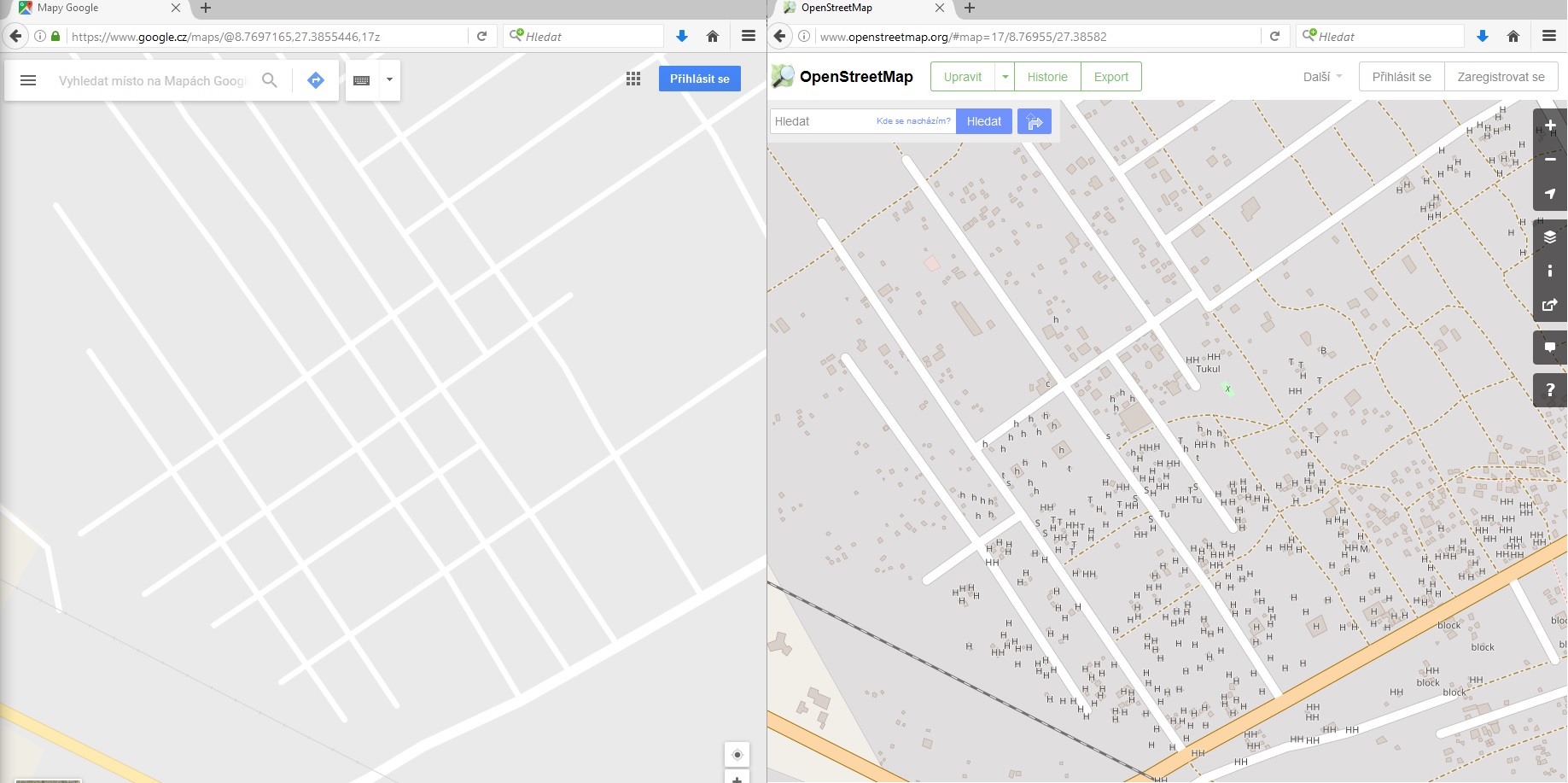
Kdy a kde to bude?
středa 18. prosince 2019 od 18:00 do 23:00
Kiwi.com office
Palachovo náměstí 4
62500 Brno-Starý Lískovec
Přesné místo mapathonu: https://www.openstreetmap.org/node/6109111100.
Registrace: https://www.eventbrite.co.uk/e/brnensky-prosincovy-missing-maps-mapathon-ve-spolecnosti-kiwicom-tickets-84144593745.
Co se na setkání bude dít?
Na mapathonu budeme společně podle satelitních snímků vytvářet v OpenStreetMap mapu jednoho z míst, na kterém působí Lékaři bez hranic.
Pokud nemáte zkušenosti, nevadí. Všechno se na místě naučíte a po krátkém školení už budete moci sami mapovat. Pokud máte zkušenosti, tím lépe. Budeme pracovat ve třech skupinách:
- Skupina začátečníků bude při školení získávat první zkušenosti s editací OpenStreetMap
- Zkušenější mapéři se budou mít možnost naučit program JOSM – volně dostupný pokročilý editor pro OpenStreetMap
- Ti, kteří už umí alespoň základy JOSM, se mohou vyškolit na validátory, kteří kontrolují výsledky práce dalších mapérů. Vyškolení co největšího počtu validátorů je aktuálně ten nejdůležitější úkol mapathonů po celém světě. Jsou nedostatkoví a vážení, tak se přidejte.
Samozřejmě, zváni jsou i zkušení uživatelé, kteří už žádné školení nepotřebují a chtějí jen nerušeně mapovat či validovat.
Pokud již patříte mezi zkušené a chtěli byste se přidat do organizačního týmu, tak se na tom na mapathonu rádi domluvíme.
Mám si něco připravit?
Pokud ještě nemáte účet na OpenStreetMap, vytvořte si ho zde: https://www.openstreetmap.org/user/new.
Pokud chcete být ve skupině pokročilých mapérů učících se JOSM, je vhodné mít na počítači předem nainstalován program JOSM. Je volně ke stažení na adrese https://josm.openstreetmap.de. Program vyžaduje nainstalovaný programovací jazyk Java.
Pokud chcete být ve skupině validátorů, je výhodou již alespoň základní znalost editoru JOSM. Ideální je proto nejdříve absolvovat mapathon ve skupině JOSM a na následujícím mapathonu přejít k validátorům.
Těší se na Vás společnost Kiwi.com, organizační tým brněnských mapathonů (Jakub, Jakub, Katka, Radim, Daniel a Michal) a občanské sdružení Amavet 962 - organizátor mapathonů na Slovensku.
Bližší informace: Radim Štampach (stampach@mail.muni.cz), Jan Bleha (jan.bleha@kiwi.com)
Brněnský prosincový Missing maps mapathon ve společnosti Kiwi.com
18.12.2019 18:00 Geografický ústav MUProsincový Missing maps mapathon ve společnosti Kiwi.com
Chcete se naladit na sváteční atmosféru? Nebo chcete na chvíli uniknout od nákupů, úklidu a pečení, tak si přijďte zamapovat. Tentokrát do firmy Kiwi.com.
Přijďte podpořit práci Lékařů bez hranic tím, že pomůžete do otevřené mapy světa OpenStreetMap zmapovat místa, která jsou ohrožena humanitárními krizemi.
Kdy a kde to bude?
středa 18. prosince 2019 od 18:00 do 23:00
Kiwi.com office
Palachovo náměstí 4
62500 Brno-Starý Lískovec
Přesné místo mapathonu: https://www.openstreetmap.org/node/6109111100.
Registrace: https://www.eventbrite.co.uk/e/brnensky-prosincovy-missing-maps-mapathon-ve-spolecnosti-kiwicom-tickets-84144593745.
Co se na setkání bude dít?
Na mapathonu budeme společně podle satelitních snímků vytvářet v OpenStreetMap mapu jednoho z míst, na kterém působí Lékaři bez hranic.
Pokud nemáte zkušenosti, nevadí. Všechno se na místě naučíte a po krátkém školení už budete moci sami mapovat. Pokud máte zkušenosti, tím lépe. Budeme pracovat ve třech skupinách:
- Skupina začátečníků bude při školení získávat první zkušenosti s editací OpenStreetMap
- Zkušenější mapéři se budou mít možnost naučit program JOSM – volně dostupný pokročilý editor pro OpenStreetMap
- Ti, kteří už umí alespoň základy JOSM, se mohou vyškolit na validátory, kteří kontrolují výsledky práce dalších mapérů. Vyškolení co největšího počtu validátorů je aktuálně ten nejdůležitější úkol mapathonů po celém světě. Jsou nedostatkoví a vážení, tak se přidejte.
Samozřejmě, zváni jsou i zkušení uživatelé, kteří už žádné školení nepotřebují a chtějí jen nerušeně mapovat či validovat.
Pokud již patříte mezi zkušené a chtěli byste se přidat do organizačního týmu, tak se na tom na mapathonu rádi domluvíme.
Mám si něco připravit?
Pokud ještě nemáte účet na OpenStreetMap, vytvořte si ho zde: https://www.openstreetmap.org/user/new.
Pokud chcete být ve skupině pokročilých mapérů učících se JOSM, je vhodné mít na počítači předem nainstalován program JOSM. Je volně ke stažení na adrese https://josm.openstreetmap.de. Program vyžaduje nainstalovaný programovací jazyk Java.
Pokud chcete být ve skupině validátorů, je výhodou již alespoň základní znalost editoru JOSM. Ideální je proto nejdříve absolvovat mapathon ve skupině JOSM a na následujícím mapathonu přejít k validátorům.
Těší se na Vás společnost Kiwi.com, organizační tým brněnských mapathonů (Jakub, Jakub, Katka, Radim, Daniel a Michal) a občanské sdružení Amavet 962 - organizátor mapathonů na Slovensku.
Bližší informace: Radim Štampach (stampach@mail.muni.cz), Jan Bleha (jan.bleha@kiwi.com)
LeddarTech to Demonstrate Automotive LiDAR Detection and Classification Technology at CES 2020 in Las Vegas
18.12.2019 17:55 GISCafe.com Webcasts-Webinars QUEBEC CITY, Dec. 18, 2019 (GLOBE NEWSWIRE) -- LeddarTech®, an industry leader in LiDAR technology providing the most versatile and …Silicon Valley Adopts NG9-1-1 GIS Technology from DATAMARK
18.12.2019 17:55 GISCafe.com Webcasts-Webinars Santa Clara County joins San Mateo and Merced Counties in NG9-1-1 transitioning efforts SANTA ANA, Calif., Dec. 18, 2019 (GLOBE NEWSWIRE) -- To …LeddarTech to Demonstrate Automotive LiDAR Detection and Classification Technology at CES 2020 in Las Vegas
18.12.2019 17:55 GISCafe.com Webcasts-Webinars QUEBEC CITY, Dec. 18, 2019 (GLOBE NEWSWIRE) -- LeddarTech®, an industry leader in LiDAR technology providing the most versatile and …Carlson Workshops
18.12.2019 16:38 Carlson Software The end of fall routinely means cold weather is on its way (at least for me) and the beginning of another season of workshops, conferences and training. As I write this blog, I just completed teaching at a three-day workshop in Raleigh, North Carolina. There were somewhere around 150 surveyors and engineers attending this workshop. […]
Hledáme nového kolegu / kolegyni pro GIS úřadu
18.12.2019 13:15 Středočeský kraj Máte rád(a) mapy a vše kolem nich? Umíte pracovat v produktech ArcGIS (Desktop, Server)? Baví Vás hledat nová řešení? Jste ochotný(á) učit se nové věci? Umíte pracovat v týmu a zároveň umíte být samostatný(á)? Je na Vás spolehnutí? Pak jste to právě Vy, koho hledáme!Instrument flying supported by EGNOS for General Aviation
18.12.2019 12:49 European GNSS AgencyEven though the General Aviation (GA) community undertakes millions of flights on aircraft equipped with GNSS-receivers, it is not taking full advantage of the technology. It is a priority of the European GNSS Agency (GSA) to support GA by facilitating instrument procedures with EGNOS. As a first step the GSA has identified enablers and blocking points along with aviation stakeholders and the European Aviation Safety Agency (EASA).
There are currently 660 EGNOS procedures in Europe, most of which are at instrument runways. However, EGNOS can also support general and business aviation on non-instrument runways. The GSA has issued safety promotion material on GNSS-based Instrument Flight Procedures implementation for General Aviation, Uncontrolled Aerodromes and Non-Instrument Runways in an effort to address this and encourage a wider use of EGNOS in general aviation.
The materials draw together the current regulatory analysis supporting EGNOS operations, along with enablers and best practices to support implementation, open issues and, last but not least, use case examples to encourage national authorities to authorise these types of operations in their countries. This includes examples showcasing how these can be implemented at locations where there are currently visual flight rules only.
Read this: EGNSS enabling change in General Aviation
High engagement
This document is aligned with the EASA Roadmap for General Aviation, which identifies simpler, more proportional rules and operations that are cost efficient, flexible and based on existing best practices. It aims to provide a view on the current implementation enablers in different EU countries and highlights the results of EASA RMTs (Rule Making Tasks) which can be relevant for the implementation of IFR for General Aviation.
“The General Aviation community undertakes millions of flights with aircraft equipped with GNSS-receivers without using the full capabilities of this new technology. By developing IFR procedures for situations where the ground infrastructure may not be present at the aerodrome it would enable GA pilots to plan A-to-B flights with more confidence of being able to complete them safely in changing weather conditions, which would have a positive impact on safety. EASA is extremely grateful to EGA for this collaborative effort,” said Dominique Roland, Head of General Aviation & Remotely Piloted Aircraft Systems at EASA.
The document will be of interest to General Aviation community, aerodromes, and air traffic control staff and national authorities alike. Publication of this document aims to start a discussion within the General aviation community, trigger future pilot cases and obtain feedback to identify the tools that should be developed to support the implementation of the IFR procedures for general aviation.
“Engagement from the aviation community has been high - we received more than 320 comments from over 25 contributors, including civil aviation authorities, air navigation service providers and others during preparation of the document. The GSA would like to thank all the contributors and supporters of this initiative, as this support was fundamental to the development of the document,” said GSA head of Market Development department Fiammetta Diani. “Special thanks go to EASA, ESSP, PPL IR, AOPA, EBAA, Austro Control, DFS, IDRF, FOCA Swiss, the Swedish Transport Agency, Europe Air Sports and the European Regional Aerodromes Community,” she said.
Just the beginning
The document will be published as a Safety Promotion material under EASA’s Together4Safety Safety Promotion initiative. This initiative is a key enabler towards reaching the ultimate objectives of the EU Aviation Safety Management Strategy and contributes to the continuous improvement of aviation safety in Europe and worldwide, together with regulations and oversight.
And this: Austro Control and EGNOS – a story of success
Publication of the materials is just the beginning. The GSA is launching a network of pilot cases in 2020 to collect lessons learned and best practices to promote and support future implementation. It is also proof that GNSS/SBAS is ready to support many different types of operations, extending beyond the traditional scope or initial objectives that the technology was designed for. If you would like to be among first to implement LPV at a non-instrument runway, you are more than welcome!
Media note: This feature can be republished without charge provided the European GNSS Agency (GSA) is acknowledged as the source at the top or the bottom of the story. You must request permission before you use any of the photographs on the site. If you republish, we would be grateful if you could link back to the GSA website (http://www.gsa.europa.eu).
Odborný referent v oddělení právních vztahů k nemovitostem Katastrálního pracoviště Chomutov na Kata
18.12.2019 12:07 ČÚZK - volná místa Katastrální úřad pro Ústecký kraj Katastrální pracoviště Chomutov vypisuje výběrové řízení na místo Odborný referent v oddělení právních vztahů k nemovitostem Katastrálního pracoviště Chomutov na KataOdborný referent v oddělení právních vztahů k nemovitostem Katastrálního pracoviště Chomutov na Kata
18.12.2019 12:07 ČÚZK /Urady/Katastralni-urady/Katastralni-urady/Katastralni-urad-pro-Ustecky-kraj/Uredni-deska/Oznameni-a-jina-uredni-sdeleni/Volna-mista/DMS/Odborny-referent-v-oddeleni-pravnich-vztahu-k-(1)Odborný referent v oddělení právních vztahů k nemovitostem Katastrálního pracoviště Chomutov na Kata
18.12.2019 12:07 ČÚZK - předpisy a opatření Katastrální úřad pro Ústecký kraj Katastrální pracoviště Chomutovvypisuje výběrové řízení na místo
Odborný referent v oddělení právních vztahů k nemovitostem Katastrálního pracoviště Chomutov na Katastrálním úřadu pro Ústecký kraj
Last calls for Horizon 2020, first views for Horizon Europe
18.12.2019 11:40 European GNSS Agency
The second day of the EU Space Week event in Helsinki opened with an overview of the final tranche of project calls under the Horizon 2020 space programme. The final Horizon 2020 EGNSS (Galileo and EGNOS) calls are now open, with a closing date of 5 March 2020. The session covered research and innovation topics across Copernicus, EGNOS and Galileo programmes and also took a look to the future with Horizon Europe.
The context of the calls, in terms of EGNSS market uptake, was described by Reinhard Blasi from the GSA. “European investments in EGNSS are already making profits, with some EUR 2.8 billion of benefits computed for 2018 alone,” he stated. Currently EGNSS market revenues represent 25% of global sales, with a target of 30% to be achieved by 2025.
Funding downstream research and innovation is an important component of the GSA’s integrated strategy to foster the adoption of EGNSS technologies and boost EU competitiveness.
The H2020-SPACE-EGNSS-2020 call is open until 5 March, has an overall indicative budget of EUR 21 million and covers four topics: EGNSS apps for green, smart transport, EGNSS for mass market digitisation, EGNSS apps for resilience and environmental protection, and EGNSS applications for public authority procurement of research. The last topic is the first attempt to use the Pre-Commercial Procurement (PCP) instrument under Horizon 2020 in the EGNSS domain.
Fundamental work
The GSA’s Fundamental Elements programme has also issued project calls with more to come. The published calls include development of an enhanced GNSS User terminal, emerging EGNSS receiver technologies, development of advanced interference systems, and the development of a drone-borne double frequency receiver. Three more calls to be published in December will cover receivers for rail applications, high precision in the mass market, and a shipborne double frequency, multi-constellation receiver.
Read this: GSA funding: Filling the gaps and emerging technologies
“There is still much to do in 2020 and beyond,” said Blasi. “The GSA has three main objectives: to complete the uptake of EGNSS in more long-term regulated markets, position Galileo as the leader with its differentiating characteristics including authentication and high accuracy, and continue to support the downstream industry.”
Eric Guyader from the European Commission outlined upcoming calls administered through the Commission’s EGNSS Mission and Services (MAS) actions. Two calls are to be published soon on R&D for EGNOS services for payment or liability critical applications in the road sector and EGNSS rail safety services.
And this: Targeting the development of a drone-borne Galileo receiver
In addition, up to eight calls may be published in 2020 under the European Space Agency administered Horizon 2020 Satellite Navigation programme (HSNAV) with some EUR 2 million earmarked for projects relating to EGNSS evolution projects.
STRIKE success
An EGNSS research success story was provided by Zahidul Bhuiyan of the Finnish National Land Survey who described the Strike-3 project funded under Horizon 2020 looking at standardisation of GNSS Interference Threat Monitoring and Receiver Testing. The project had set up an international network to monitor GNSS interference. “GNSS needs protection,” said Bhuiyan. “STRIKE-3 aimed to improve our understanding of the threat scene facing stakeholders in implementing GNSS safety and security.”
The project found that out of over half a million monitored interference events, both unintentional and malicious, only 5% had an impact on the receiver, with the vast majority not actually denying the use of GNSS. The project reinforced the recognition that improved interference detection and mitigation can help the robustness of PNT services, in particular for critical infrastructure, and its receiver testing standard document provides a good initial test standard to ensure that reports from different systems are compatible.
Horizon Europe
Although the budget for the next Framework R&D programme for 2021-2027, Horizon Europe, is still subject to negotiation Mats Ljungqvist of DG GROW gave an overview of the current state of play. The current budget for the EU Space Programme in Horizon Europe is EUR 16 billion with some EUR 9.7 billion allocated to EGNSS topics.
An orientation document on the first strategic plan and work programme for Horizon Europe published at the end of October contains two sections on space research and innovation: 4.8 ‘A globally competitive space sector reinforcing EU sovereignty’ and 4.11 ‘New services from Space for the EU society and economy’.
Within the three pillars of Horizon Europe, Pillar 2 on Global Challenges and Industrial Competitiveness is allocated around half the total budget and includes a cluster (Digital, Industry & Space) that directly addresses space topics. “Pillar 3 on Open Innovation will also be of interest to the space sector,” said Ljungqvist. “An Enhanced European Innovation Council will provide accelerator and pathfinder grants to help bring bright ideas to market.”
Higher innovation funding should also be made available via an enhanced InvestEU programme where a European Union guarantee of some EUR 40 billion is looking to mobilise up to EUR 700 billion of private investment for growth and scale-up.
Together with a new Commission Directorate-General for Defence and Space, starting work at the beginning of 2020, there is a clear focus for space-related strategy and activities in Europe that reflect the growing importance of the space sector.
The GSA and the Commission have also been consulting with GNSS user communities to take their input into consideration when defining EGNSS downstream funding priorities in the new financial perspective. A recent report from the GSA summarises the results of these consultations and outlines future R&I priorities.
Media note: This feature can be republished without charge provided the European GNSS Agency (GSA) is acknowledged as the source at the top or the bottom of the story. You must request permission before you use any of the photographs on the site. If you republish, we would be grateful if you could link back to the GSA website (http://www.gsa.europa.eu).
Earth observation + icon
18.12.2019 11:32 ESA Observing the Earth
ESA Earth observation
ESA Earth observation
MyGalileoApp shines spotlight on opportunities for start-ups
18.12.2019 11:04 European GNSS Agency
Concrete funding opportunities that are available to space tech start-ups were in focus at the MyGalileoApp competition, held at the European GNSS Agency’s (GSA) headquarters in Prague on 7 November. At an investors panel discussion held as part of the event, start-ups heard about some of the concrete funding opportunities that are available to them.
Kicking-off the panel discussion, Marta Krywanis-Brzostowska, Head of Downstream R&D in the GSA Market Development Department, noted that the Agency currently has a portfolio of over 60 projects worth a total of over EUR 120 million. She said that, through Horizon 2020, the GSA is supporting the development of applications, while the Fundamental Elements mechanism targets the development of hardware, such as chipsets and receivers.
Noting that funding is also made available through aviation grants and smaller initiatives like MyGalileoApp and other prizes such as the Galileo Masters and Farming by Satellite, Krywanis-Brzostowska said that start-ups stand to receive more dedicated support in the future.
Dedicated start-up programme
“We are aware that there is a need to support start-ups, this is why in the new financial framework after 2020 we are planning, along with the European Commission, to define a dedicated programme that will support start-ups,” she said.
Read this: EU space infrastructure guarantees leadership in security and defence
Thierry Chapuis, space applications expert at CNES (Centre National d’Etudes Spatiales) in France spoke about some of the support available through his organisation, in particular the Connect by CNES initiative, which was set up to help private and public actors to develop their applications. CNES is also participating in and funding the ESA Business Incubation Centres at the French national level. CNES is also working at the aviation level and organising hackathons such as Act in Space, the next edition of which will be in April 2020, he said.
Like Krywanis-Brzostowska, Chapuis also noted that start-ups stood to benefit from some dedicated support. “The French government has decided to develop start-ups and a big budget of EUR 400 million has been approved. CNES is responsible for selecting start-ups related to space activities within this programme,” he said.
Advancing to the next stage
João Duarte, responsible for early stage venture capital at Lighthouse Ventures, a EUR 23-million fund based in Prague, said that his company supports early stage start-ups with between 50,000 to 700,000 euros per start-up, with EUR 300,000 being the most typical amount. “We also have an acceleration programme where we invest EUR 20,000 for a couple of months to help a start-up go from the idea stage to having a business plan and some early customers. If they successfully complete the acceleration, then they will be eligible for larger investment to take them to the next stage,” he said.
And this: GSA, EIB sign agreement on investment in space
Representing UP21, an incubator and seed fund based in Prague, Anna Efros informed the participants that, so far her company had carried out 16 investments in two strategies: incubation with up to EUR 30,000 for 3-6 months, and larger investments of up to EUR 500,000 euros. “We are currently setting up a venture capital fund called START21 which will hopefully amount to EUR 25 million, and also we are co-organiser of the Start-up World Cup and Summit, which will be held in April 2020,” she said.
Money to disperse
Unlike other similar agencies, the Italian Space Agency doesn’t have its own research labs. However, Anilkumar Dave, Head of Innovation and Transfer of Technologies at the Agency, said that it has a lot of government money to disburse. “We will launch the first venture capital fund on space in Italy at the end of this year, where we are the cornerstone investor - but we will not invest in early-stage and seed, but rather in SMEs,” he said.
Marketa Filipenska, International Funding Specialist at the South Moravian Innovation Centre (JIC) noted that her centre had recently opened a European Space Agency BIC where it is helping people with ideas related to space upstream and downstream. “We are providing them with EUR 50,000 and business mentoring, in addition to connecting them to big players in the sector,” she said.
Wrapping up the discussion, Fiammetta Diani, Head of Market Development at the GSA, spoke about a Memorandum of Understanding that the GSA signed with the European Investment Bank (EIB) in September this year, dealing with cooperation on supporting investment in the European space-based service economy. “The MoU aims to give space start-ups a greater portfolio of opportunities and tools to help them to grow,” she said.
Media note: This feature can be republished without charge provided the European GNSS Agency (GSA) is acknowledged as the source at the top or the bottom of the story. You must request permission before you use any of the photographs on the site. If you republish, we would be grateful if you could link back to the GSA website (http://www.gsa.europa.eu).
Mapujeme drony skalní útvary pro výzkumné projekty Univerzity Karlovy tentokrát v Saském Švýcarsku
18.12.2019 10:33 UpVisionProvádíme průběžně letecké mapování různých skalních útvarů pomocí LiDARu i fotogrammetrie pro výzkumné úkoly, jako tentokrát nedaleko za hranicemi v Saském Švýcarsku. Provádíme průběžně letecké mapování různých skalních útvarů pomocí LiDARu i fotogrammetrie pro výzkumné úkoly, jako tentokrát nedaleko za hranicemi v Saském Švýcarsku. Zveřejnil(a) UpVision dne Úterý 17. prosince 2019
The post Mapujeme drony skalní útvary pro výzkumné projekty Univerzity Karlovy tentokrát v Saském Švýcarsku appeared first on Upvision.
rada/odborný rada - právník
18.12.2019 9:58 ČÚZK /Urady/Katastralni-urady/Katastralni-urady/Katastralni-urad-pro-hlavni-mesto-Prahu/O-uradu/Aktuality/rada-odborny-rada-pravnikrada/odborný rada - právník
18.12.2019 9:58 ČÚZK - předpisy a opatření Katastrální úřad pro hlavní město Prahu - Katastrální pracoviště Praha zveřejnil novou aktualitu: Ředitel úřadu vyhlašuje výběrové řízení na služební místo: rada/odborný rada - právníkrada/odborný rada - právník
18.12.2019 9:58 ČÚZK - předpisy a opatření Katastrální úřad pro hlavní město Prahu zveřejnil novou aktualitu: Ředitel úřadu vyhlašuje výběrové řízení na služební místo: referent KN – kontrolorreferent KN – vedení DKM, vedení katastrální mapy
18.12.2019 9:58 ČÚZK - předpisy a opatření Katastrální úřad pro hlavní město Prahu zveřejnil novou aktualitu: Ředitel úřadu vyhlašuje výběrové řízení na služební místo: referent KN – vedení DKM, vedení katastrální mapy20191218- Provoz 31.12
18.12.2019 9:51 ČÚZK /Urady/Katastralni-urady/Katastralni-urady/Katastralni-urad-pro-Karlovarsky-kraj/O-uradu/Aktuality/20191218-Provoz-31-1220191218- Provoz 31.12
18.12.2019 9:51 ČÚZK - předpisy a opatření Katastrální úřad pro Karlovarský kraj zveřejnil novou aktualitu: Katastrální úřad pro Karlovarský kraj Vás informuje, že z provozních důvodů bude možno dne 31. 12. 2019 hradit veškeré poplatky na katastrálních pracovištích Karlovy Vary, Sokolov a Cheb pouze platební kartou, nebo donesenou kolkovou známkou.Děkujeme Vám za pochopení.
rada/odborný rada - právník
18.12.2019 9:50 ČÚZK - předpisy a opatření Katastrální úřad pro hlavní město Prahuvypisuje výběrové řízení na místo
rada/odborný rada - právník
rada/odborný rada - právník
18.12.2019 9:50 ČÚZK - předpisy a opatření Katastrální úřad pro hlavní město Prahu Katastrální pracoviště Prahavypisuje výběrové řízení na místo
rada/odborný rada - právník
rada/odborný rada - právník
18.12.2019 9:50 ČÚZK - volná místa Katastrální úřad pro hlavní město Prahu - Katastrální pracoviště Praha vypisuje výběrové řízení na místo rada/odborný rada - právníkrada/odborný rada - právník
18.12.2019 9:50 ČÚZK - předpisy a opatření Katastrální úřad pro hlavní město Prahu - Katastrální pracoviště Prahavypisuje výběrové řízení na místo
rada/odborný rada - právník
rada/odborný rada - právník
18.12.2019 9:50 ČÚZK - volná místa Katastrální úřad pro hlavní město Prahu Katastrální pracoviště Praha vypisuje výběrové řízení na místo rada/odborný rada - právníkrada/odborný rada - právník
18.12.2019 9:50 ČÚZK /Urady/Katastralni-urady/Katastralni-urady/Katastralni-urad-pro-hlavni-mesto-Prahu/Uredni-deska/Oznameni-a-jina-uredni-sdeleni/Volna-mista/DMS/rada-odborny-rada-pravnik-(2)rada/odborný rada - právník
18.12.2019 9:50 ČÚZK - volná místa Katastrální úřad pro hlavní město Prahu vypisuje výběrové řízení na místo rada/odborný rada - právníkProstorové simulační modelování dopravní dostupnosti
18.12.2019 9:15 Katedra geoinformatiky UP OlomoucDalší kniha na obzoru 👌 V těchto dnech vyšla další monografie s názvem Prostorové simulační modelování dopravní dostupnost z ediční řady Geographica 🌍 Kniha vznikla v širším kolektivu autorů vedené doc. Jiřím Horákem a doc. Jaroslavem Burianem, a kromě jiných se na ní podílela v značné míře dr. Lenka Zajíčková, nebo i prof. Vít Voženílek 🤓 https://geography.cz/prispevek/nova-monografie-v-edici-geographica/?fbclid=IwAR1omCQCXRU6xQgOqeNCo_ygsB41hvLw3wSsYyGZVOGRrtgOL1b95ZIoOzY
The post Prostorové simulační modelování dopravní dostupnosti appeared first on Katedra geoinformatiky.
rada/odborný rada – inspektor Zeměměřického a katastrálního inspektorátu v Pardubicích
18.12.2019 9:08 ČÚZK - předpisy a opatření Zeměměřický a katastrální inspektorát v Pardubicíchvypisuje výběrové řízení na místo
rada/odborný rada – inspektor Zeměměřického a katastrálního inspektorátu v Pardubicích
rada/odborný rada – inspektor Zeměměřického a katastrálního inspektorátu v Pardubicích
18.12.2019 9:08 ČÚZK /Urady/Zememericke-a-katastralni-inspektoraty/Zememericke-a-katastralni-inspektoraty/Zememericky-a-katastralni-inspektorat-v-Pardubicic/Uredni-deska/Oznameni-a-jina-uredni-sdeleni/Volna-mista/DMS/rada-odborny-rada-–-inspektor-Zememerickeho-a-katarada/odborný rada – inspektor Zeměměřického a katastrálního inspektorátu v Pardubicích
18.12.2019 9:08 ČÚZK - volná místa Zeměměřický a katastrální inspektorát v Pardubicích vypisuje výběrové řízení na místo rada/odborný rada – inspektor Zeměměřického a katastrálního inspektorátu v PardubicíchUpozornění
18.12.2019 9:07 ČÚZK - předpisy a opatření Katastrální úřad pro Vysočinu - Katastrální pracoviště Havlíčkův Brod zveřejnil novou aktualitu: Ve dnech 30.-31.12.2019 lze z technických důvodů správní poplatky uhradit pouze kolkovými známkami, bezhotovostním převodem nebo platebními kartami.Děkujeme za pochopení.
Upozornění
18.12.2019 9:07 ČÚZK /Urady/Katastralni-urady/Katastralni-urady/Katastralni-urad-pro-Vysocinu/Katastralni-pracoviste/KP-Havlickuv-Brod/O-uradu/Aktuality/UpozorneniSHIFT RED Next Generation Drone System creates New Style beyond UAV
17.12.2019 21:38 GISCafe.com Webcasts-Webinars SEOUL, KOREA, Dec 18, 2019 - (ACN Newswire) - TIE (this is engineering, Inc.), a global leader in UAV and Robotics technology and products, is …Presentation Proposals Invited for GIS-Pro 2020 in Baltimore
17.12.2019 21:31 GISCafe.com Webcasts-Webinars Des Plaines, IL (December 17, 2019) URISA is pleased to invite presentation proposals for GIS-Pro 2020 in Baltimore. The conference will …General Land Office Preserves More Than 45,000 Maps, Surveys and Sketches with a Contex Large Format Scanner
17.12.2019 20:45 GISCafe.com Webcasts-Webinars The Market’s Fastest, Most Productive Scanner Boosts Agency’s Productivity by 25%
Chantilly, VA — December 17, 2019 …
OGC announces virtualcitySYSTEMS as the winner of the 2019 OGC CityGML Challenge
17.12.2019 20:05 GISCafe.com Webcasts-Webinars The winning spot was awarded for creating the CityGML 3 visualization tool with the most comprehensive data integration environment, 3D analysis …Connecticut Signs Participating Addendum with DroneUp Providing Public Sector Agencies Access to Drone Services
17.12.2019 19:58 GISCafe.com Webcasts-Webinars VIRGINIA BEACH, Va., Dec. 17, 2019 — (PRNewswire) — DroneUp, LLC signed a Participating Addendum with the State of Connecticut …AerialSphere and iFoundAgent Partner to Provide 'Addictive' 360-Degree, Interactive, Immersive Mapping Technology for Websites
17.12.2019 19:58 GISCafe.com Webcasts-Webinars PHOENIX, Dec. 17, 2019 — (PRNewswire) — AerialSphere, an innovative tech startup creating immersive and interactive 360-degree maps, is …Skyfire Consulting and Skydas Group Team Up to Offer POST-Certified Drone Training, Ramp Up Law Enforcement and Event Offerings
17.12.2019 19:58 GISCafe.com Webcasts-Webinars ATLANTA, Dec. 17, 2019 — (PRNewswire) — Skyfire Consulting - the country's leading public safety drone consultancy - is teaming up with …Woolpert Contracted to Map and Survey Mines Via Unmanned Aircraft Systems (UAS)
17.12.2019 19:58 GISCafe.com Webcasts-Webinars The firm is using drones and manned aircraft to help safely and effectively manage mining operations and assets.DAYTON, Ohio, Dec. 17, 2019 — …
Methane leak visible from space
17.12.2019 16:55 ESA Observing the Earth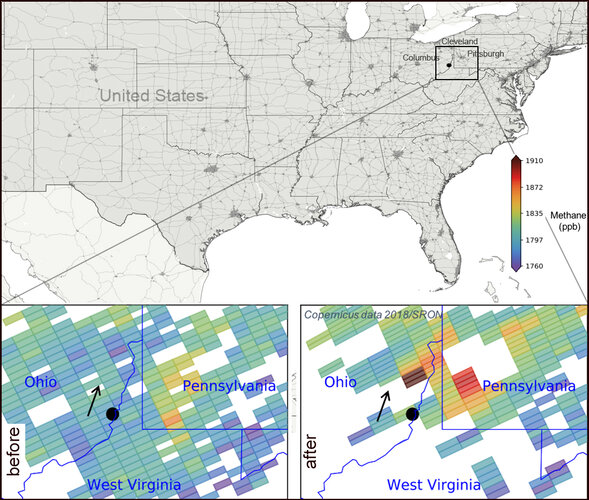 Image:
Data from the Copernicus Sentinel-5P satellite revealed that an explosion in a natural gas well in Ohio in February 2018 released more than 50 000 tons of methane into the atmosphere. The blowout leaked more of this potent greenhouse gas in 20 days than the majority of many European nations do in a year from their oil and gas industries.
Data from the Copernicus Sentinel-5P’s Tropomi instrument revealed that 120 tons of methane were emitted per hour due to the blowout. The findings were published in a study yesterday in the Proceedings of the National Academy of Sciences, and reveals the importance of using satellite data to detect and quantify pollutants such as methane.
The location of the explosion is marked by a black dot in the image, and shows the methane emissions before and after the blowout. The black arrow indicates the wind direction and the direction of the methane plume.
Claus Zehner, ESA’s Copernicus Sentinel-5P mission manager, comments, “These Sentinel-5P measurements show that satellites can measure the concentrations of greenhouse gases emitted by a point source. The satellite’s capabilities will be further exploited with the upcoming Copernicus Carbon Dioxide Monitoring mission.”
While carbon dioxide is more abundant in the atmosphere and therefore more commonly associated with global warming, methane is about 30 times more potent as a heat-trapping gas. It usually enters the atmosphere mainly from the fossil fuel industry, landfill sites, livestock farming, rice agriculture and wetlands – but can also be released during oil and gas extraction.
Sentinel-5P, with its state-of-the-art instrument Tropomi, can also map other pollutants such as nitrogen dioxide, carbon monoxide, sulphur dioxide and aerosols – all of which affect the air we breathe and our climate.
Methane leak visible from space
17.12.2019 16:55 ESA Observing the Earth
Image:
Data from the Copernicus Sentinel-5P satellite revealed that an explosion in a natural gas well in Ohio in February 2018 released more than 50 000 tons of methane into the atmosphere. The blowout leaked more of this potent greenhouse gas in 20 days than the majority of many European nations do in a year from their oil and gas industries.
The findings were published in a study yesterday in the Proceedings of the National Academy of Sciences, and the study reveals the importance of using satellite data to detect and quantify pollutants such as methane. Data from the Copernicus Sentinel-5P’s Tropomi instrument revealed that 120 tons of methane were emitted per hour due to the blowout.
The location of the explosion is marked by a black dot in the image, and shows the methane emissions before and after the blowout. The black arrow indicates the wind direction and the direction of the methane plume.
Claus Zehner, ESA’s Copernicus Sentinel-5P mission manager, comments, “These Sentinel-5P measurements show that satellites can measure the concentrations of greenhouse gases emitted by a point source. The satellite’s capabilities will be further exploited with the upcoming Copernicus Carbon Dioxide Monitoring mission.”
While carbon dioxide is more abundant in the atmosphere and therefore more commonly associated with global warming, methane is about 30 times more potent as a heat-trapping gas. It usually enters the atmosphere mainly from the fossil fuel industry, landfill sites, livestock farming, rice agriculture and wetlands – but can also be released during oil and gas extraction.
Sentinel-5P, with its state-of-the-art instrument Tropomi, can also map other pollutants such as nitrogen dioxide, carbon monoxide, sulphur dioxide and aerosols – all of which affect the air we breathe and our climate.
Simulyze Selected as a Winner in the 2019 "NVTC Tech 100" Awards for Second Consecutive Year
17.12.2019 16:46 GISCafe.com Webcasts-Webinars Simulyze recognized as a leading provider of operational intelligence technology and applications for the region by the Northern Virginia Technology …NICB Uses GIC Imagery To Uncover Disaster Fraud Case In Marshalltown, Iowa
17.12.2019 16:46 GISCafe.com Webcasts-Webinars DES PLAINES, Ill., Dec. 17, 2019 — (PRNewswire) — The National Insurance Crime Bureau (NICB) released a video today detailing how …Rand McNally Launches Advanced Truck Tablet with All-New Navigation 2.0
17.12.2019 16:46 GISCafe.com Webcasts-Webinars The TND™ Tablet 85 also features a directional dash cam and stronger magnetic mountCHICAGO, Dec. 17, 2019 — (PRNewswire) — Rand …
Inaugural European Aerial Survey Summit Attracts Worldwide Audience
17.12.2019 16:44 GISCafe.com Webcasts-Webinars Brussels, 17 December 2019 - Delegates from around the world flocked to the first European Association of Aerial Surveying Industries (EAASI) Summit. …Silvestr 2019
17.12.2019 13:01 ČÚZK - předpisy a opatření Katastrální úřad pro Moravskoslezský kraj - Katastrální pracoviště Karviná zveřejnil novou aktualitu: Vážení klienti,z provozních důvodů bude možno dne 31.12.2019 hradit správní poplatky v hotovosti pouze do 10:00 hodin.
Od 10:00 do 15:00 hodin bude možno platit správní poplatek platební kartou, kolkovou známkou nebo převodem z účtu, na základě podkladu pro platbu, který vám vystaví zaměstnanec podatelny.
Děkujeme za pochopení.
Silvestr_2019
17.12.2019 13:01 ČÚZK /Urady/Katastralni-urady/Katastralni-urady/Katastralni-urad-pro-Moravskoslezsky-kraj/Katastralni-pracoviste/KP-Karvina/O-uradu/Aktuality/Silvestr_2019Silvestr 2019
17.12.2019 13:01 ČÚZK /Urady/Katastralni-urady/Katastralni-urady/Katastralni-urad-pro-Moravskoslezsky-kraj/Katastralni-pracoviste/KP-Karvina/O-uradu/Aktuality/Silvestr_2019Silvestr 2019
17.12.2019 13:01 ČÚZK - předpisy a opatření Katastrální úřad pro Moravskoslezský kraj - Katastrální pracoviště Karviná zveřejnil novou aktualitu: Vážení klienti,z provozních důvodů bude možno dne 31.12.2019 hradit správní poplatky v hotovosti pouze do 10:00 hodin.
Od 10:00 do 15:00 hodin bude možno platit správní poplatek platební kartou, kolkovou známkou nebo převodem z účtu, na základě podkladu pro platbu, který vám vystaví zaměstnanec podatelny.
Děkujeme za pochopení.
Silvestr_2019
17.12.2019 13:01 ČÚZK - předpisy a opatření Český úřad zeměměřický a katastrální - Katastrální pracoviště Karviná zveřejnil novou aktualitu: Vážení klienti,Katastrální úřad pro Moravskoslezský kraj, Katastrální pracoviště Karviná Vás informuje, že z provozních důvodů, vzhledem k upravené pracovní době České pošty, bude možno dne 31. 12. 2019 hradit veškeré poplatky spojené s činností Katastrálního pracoviště Karviná v hotovosti pouze do 10:00 hodin.
Od 10:00 do 15:00 hodin bude možno poplatky hradit platební kartou, kolkovou známkou nebo převodem z účtu na základě podkladu pro platbu, který vám vystaví zaměstnanec podatelny.
Děkujeme Vám za pochopení.
MyGalileoApp – an ecosystem of innovation
17.12.2019 12:04 European GNSS Agency
The MyGalileoApp competition has contributed to the creation of an ecosystem that helps start-ups and other innovators to build innovative applications and grow while enabling both private and public investors to find and invest in projects of interest to them. At the MyGalileoApp finals, which took place at the European GNSS Agency’s (GSA) Prague headquarters at the start of November, start-ups heard about some of the key elements that they will need to succeed in a highly-competitive marketplace.
Galileo has been available to users around the globe since the launch of initial services back in December 2016 and the challenge generally, and for the MyGalileoApp competition specifically, is to make use of the Galileo services to develop systems and applications and to drive innovation based on the technology that Galileo makes available. The competition took nine months in total, during which the competitors progressed from the idea stage to creating a working app with 100% functionality.
Engines of innovation
Francesco Perticarari from Silicon Roundabout, who was a mentor at this year’s competition, noted that the approach of the GSA has been to leverage start-ups as engines of innovation. “The GSA did not just set up a competition to award money to successful developers, it set out to create an ecosystem of tech innovators, from start-ups to mentors and investors and the GSA itself, which also provides support,” he said, adding that the power of the MyGalileoApp competition is the ecosystem it creates that enables start-ups to deliver.
“Whether or not you win a prize today, this is not the end of the story. The connections you have made with mentors, investors and other start-ups are what you should really treasure,” he told the finalists in this year’s competition.
Watch this: Meet Argeo: #MyGalileoApp Competition Winner
Another mentor, Piotr Bucki from Bucki PRO, outlined some of the forces that can drive a start-up forward, including social demographics in the form of a trend that an app can follow. It is also possible to ride a regulatory wave. “If rules from the European Commission or some other authority call for improvements in a service, then companies have no choice but to up their game, he said.
Growth mind-set
“In addition to timing, financing, strategy and riding the aforementioned waves, one more thing that makes start-ups successful is having a growth mind-set. A growth mind-set is the opposite of a fixed mind-set, in which intelligence is static, while in a growth mind-set intelligence and skills can be developed and iterated,” Bucki said.
Maaike Dokter from Xablu noted that location services can improve our quality of life, and that this was true for all of the sectors addressed by the MyGalileoApp finalists’ apps. As a designer with a focus on healthcare, she outlined how location-based services can improve things in this industry by optimising processes and reducing admin, allowing providers to focus on healthcare provision and reducing the amount of time a person has to spend in hospital.
“By increasing outdoor and indoor accuracy, we can take advantage of these opportunities. The MyGalileoApp competitors are finding solutions in which Galileo plays an important role, turning ideas into reality,” she said.
Ensuring sustainability
At a panel discussion held later in the day, start-ups heard from investors about the key qualities that would ensure their sustainability. Marketa Filipenska, International Funding Specialist at the South Moravian Innovation Centre (JIC) said that, in addition to mentoring, complementary services are also important, closely linked to the ecosystem in the region.
Read this: EGNOS service for payment and liability-critical road applications
“We connect venture capital funds, business angels, universities, local stakeholders and corporates - all of these meet with our start-ups and clients to identify opportunities on the market. Investor matching is important, not only to make the business sustainable, but to scale up the company,” she said.
Marta Krywanis-Brzostowska, Head of Downstream R&D in the GSA Market Development Department, noted that when reviewing projects for funding, one thing at the forefront of the GSA’s mind is that it does not want another prototype to put on the shelf.
“We always highlight that it is important to have a link between the proposed solution and needs on the market. Knowledge of the market is critical, so we ask applicants to include a business plan along with their proposals,” she said, adding that an important tool in understanding the market is the GSA’s GNSS Market Report.
“To be sustainable, you have to follow trends, be creative, understand the technology, be enthusiastic about what you are doing and be open to any support,” she said.
Thanks to MyGalileoApp, the GSA has built a network where business partners, public players and investors can connect with start-ups and young innovators, thereby contributing to the development of innovative applications leveraging the advantages of Galileo.
Media note: This feature can be republished without charge provided the European GNSS Agency (GSA) is acknowledged as the source at the top or the bottom of the story. You must request permission before you use any of the photographs on the site. If you republish, we would be grateful if you could link back to the GSA website (http://www.gsa.europa.eu).
Vedení katastrální mapy v oddělení aktualizace KN
17.12.2019 11:43 ČÚZK - volná místa Katastrální úřad pro Zlínský kraj Katastrální pracoviště Vsetín vypisuje výběrové řízení na místo Vedení katastrální mapy v oddělení aktualizace KNVedení katastrální mapy v oddělení aktualizace KN
17.12.2019 11:43 ČÚZK - předpisy a opatření Katastrální úřad pro Zlínský kraj Katastrální pracoviště Vsetínvypisuje výběrové řízení na místo
Vedení katastrální mapy v oddělení aktualizace KN
Vedení katastrální mapy v oddělení aktualizace KN
17.12.2019 11:43 ČÚZK /Urady/Katastralni-urady/Katastralni-urady/Katastralni-urad-pro-Zlinsky-kraj/Uredni-deska/Oznameni-a-jina-uredni-sdeleni/Volna-mista/DMS/Vedeni-katastralni-mapy-v-oddeleni-aktualizace-KNSilvestr_2019
17.12.2019 11:19 ČÚZK - předpisy a opatření Katastrální úřad pro Moravskoslezský kraj - Katastrální pracoviště Ostrava zveřejnil novou aktualitu: Vážení klienti,z provozních důvodů bude možno dne 31.12.2019 hradit poplatky v hotovosti pouze do 11 hodin.
Od 11:00-15:00 hodin bude možno platit poplatek platební kartou, kolkovou známkou nebo převodem z účtu, na základě podkladu pro platbu, který vám vystaví zaměstnanec podatelny.
Děkujeme za pochopení.
Silvestr 2019
17.12.2019 11:19 ČÚZK - předpisy a opatření Katastrální úřad pro Moravskoslezský kraj - Katastrální pracoviště Ostrava zveřejnil novou aktualitu: Vážení klienti,z provozních důvodů bude možno dne 31.12.2019 hradit správní poplatky v hotovosti pouze do 11:00 hodin.
Od 11:00 do 15:00 hodin bude možno platit správní poplatek platební kartou, kolkovou známkou nebo převodem z účtu, na základě podkladu pro platbu, který vám vystaví zaměstnanec podatelny.
Děkujeme za pochopení.
Silvestr 2019
17.12.2019 11:19 ČÚZK - předpisy a opatření Katastrální úřad pro Moravskoslezský kraj - Katastrální pracoviště Ostrava zveřejnil novou aktualitu: Vážení klienti,z provozních důvodů bude možno dne 31.12.2019 hradit správní poplatky v hotovosti pouze do 11:00 hodin.
Od 11:00 do 15:00 hodin bude možno platit správní poplatek platební kartou, kolkovou známkou nebo převodem z účtu, na základě podkladu pro platbu, který vám vystaví zaměstnanec podatelny.
Děkujeme za pochopení.
Silvestr 2019
17.12.2019 11:19 ČÚZK /Urady/Katastralni-urady/Katastralni-urady/Katastralni-urad-pro-Moravskoslezsky-kraj/Katastralni-pracoviste/KP-Ostrava/O-uradu/Aktuality/Silvestr_2019Silvestr_2019
17.12.2019 11:19 ČÚZK /Urady/Katastralni-urady/Katastralni-urady/Katastralni-urad-pro-Moravskoslezsky-kraj/Katastralni-pracoviste/KP-Ostrava/O-uradu/Aktuality/Silvestr_2019Galileo Masters 2019: Something special in the Air in Helsinki?
17.12.2019 11:11 European GNSS Agency
Once again, the Galileo Masters – and its sister award programme the Copernicus Masters – was the glittering highlight of EU Space Week 2019 that took place in Helsinki on 3 to 5 December. In its 15th year the Galileo Masters continues to attract the attention of some of the brightest and best minds. Topics submitted to the competition this year ranged through digitisation, big data, the sharing economy and artificial intelligence (AI), amongst others, but all with a common theme: the use of European Global Navigation Satellite Systems (EGNSS) Galileo and/or EGNOS to benefit society.
The 2019 Galileo Masters attracted some 203 participants reaching entrepreneurs from over 41 countries in Europe and around the world. Since its inception in 2004 the competition has seen a cumulative participation by just under 12,000 individuals submitting 4,587 individual business cases.
In addition to the overall Galileo Masters winner and regional awards, a range of special prizes are also given, including ‘Idea of the Year’ and ‘Start-up of the Year’ and a new prize for 2019 responding to an emerging trend: The Galileo-Copernicus Synergy Challenge.
Special prizes
The Gala event took place at the Helsinki Congress Paasitorni centre in central Helsinki on the evening of 4 December. In all, some 31 awards were handed out on the night under the Galileo Masters categories. Master of ceremonies, Bavarian broadcaster and celebrity Claus Kruesken, described the Masters awards ceremony as the “festive highlight of EU Space Week.”
Read this: Performance Cockpit takes overall prize at Galileo Masters 2019
This year’s new prize, the GSA Galileo-Copernicus Synergy Challenge was presented by GSA Executive Director Carlo des Dorides. Commenting on the event, he highlighted the links that the competition inspired between the GSA and the space applications community by “providing the GSA with a first-hand experience of emerging needs and solutions.” The first ever winner of the synergy prize was the Xylene concept from Giuseppe Benenati and his team. Read more here.
Other Galileo special prizes this year included the DLR Artificial Intelligence Navigation Challenge awarded to Pieter Bastiaan Ober of INTEGRICOM for a proposal to analyse the Galileo Signal in Space using AI. The BMVI PRS Applications Challenge was presented to Brandon Bradford of tissEU for his Odin’s Eye idea – a Galileo-enabled PRS tactical drone – that was also the winner of the Bavaria regional Challenge prize.
The University Challenge was announced by Paul Bhatia from the University of Nottingham with the winner, Freewheel – a platform that allows people with reduced mobility to increase their accessibility and inclusion – awarded to Lotfi Massarweh, Deimos Engenharia and their Elecnor team.
The SAWCER concept won the GNSS Living Lab Prize with an idea inspired by a move to a new city, Barcelona, for winner Adrienne Fanning. Her app makes local shops as easy to search as online stores by creating and sharing crowdsourced, geo-localised catalogues.
The internet of Things (IoT) is building to be one of Galileo’s largest markets for applications and the Galileo 5G IoT Challenge award was presented to another idea to help inclusivity by making outdoor sports more accessible to blind or partially sighted people: the WAIBRO belt developed by Katrina Sedlackova and her team at WAIBRO sports.
New ideas and accelerators
Fiammetta Diani, Deputy Head of Market Development at the GSA presented the Idea of the Year and Start-up of the Year prizes; both of which target entrepreneurship. Idea of the Year went to the CX-GEODRONE project and a joint team from the Universities of Vigo and Oviedo, who also won the Galicia regional prize, for a radar-based drone payload that promised the inspection of underground utilities infrastructure without the need to dig up the road.
And this: uMaze takes Accuracy Matters prize in Galileo Innovation Challenge
The Start-up of the Year is awarded to a project that is already being implemented in a start-up that is not older than three years and this year was awarded to PODIS - Post Distress Signal. The winning team led by Andreas Alamanos also won the Greek regional prize for this IoT solution-as-a-service concept for automatic crash notification system.
The prestigious EGNSS Accelerator Winners were announced by Pierre Delsaux, Deputy Director-General for Internal Market, Industry, Entrepreneurship and SMEs at the European Commission. Three winners were announced for the valuable incubation prize. First up was MEDeus, aka the drone doctors, represented by Hammad Jeilani and his UK regional winning team that is looking to improve the efficiency of delivering healthcare supplies using drones.
Another double winner was second: Dronetag also won the Czech regional prize for Lukaz Brchl. The Dronetag concept will provide real-time identification for UAVs by leveraging Galileo and IoT technologies.
The third Incubation winner was in fact a triple success for the German Tocsen GmbH team. Tocsen won the Baden-Wurttemberg regional prize, took this Incubation Accelerator win and was on stage again as the single winner of the EGNSS crowdfunding campaign accelerator! Tocsen is a smart crash detection and automatic emergency call system designed to be incorporated in cyclists’ crash helmets.
Media note: This feature can be republished without charge provided the European GNSS Agency (GSA) is acknowledged as the source at the top or the bottom of the story. You must request permission before you use any of the photographs on the site. If you republish, we would be grateful if you could link back to the GSA website (http://www.gsa.europa.eu).
Galileo Masters 2019: Something special in the Air in Helsinki?
17.12.2019 11:11 European GNSS AgencyOnce again, the Galileo Masters – and its sister award programme the Copernicus Masters – was the glittering highlight of EU Space Week 2019 that took place in Helsinki on 3 to 5 December. In its 15th year the Galileo Masters continues to attract the attention of some of the brightest and best minds. Topics submitted to the competition this year ranged through digitisation, big data, the sharing economy and artificial intelligence (AI), amongst others, but all with a common theme: the use of European Global Navigation Satellite Systems (EGNSS) Galileo and/or EGNOS to benefit society.
The 2019 Galileo Masters attracted some 203 participants reaching entrepreneurs from over 41 countries in Europe and around the world. Since its inception in 2004 the competition has seen a cumulative participation by just under 12,000 individuals submitting 4,587 individual business cases.
In addition to the overall Galileo Masters winner and regional awards, a range of special prizes are also given, including ‘Idea of the Year’ and ‘Start-up of the Year’ and a new prize for 2019 responding to an emerging trend: The Galileo-Copernicus Synergy Challenge.
Special prizes
The Gala event took place at the Helsinki Congress Paasitorni centre in central Helsinki on the evening of 4 December. In all, some 31 awards were handed out on the night under the Galileo Masters categories. Master of ceremonies, Bavarian broadcaster and celebrity Claus Kruesken, described the Masters awards ceremony as the “festive highlight of EU Space Week.”
Read this: Performance Cockpit takes overall prize at Galileo Masters 2019
This year’s new prize, the GSA Galileo-Copernicus Synergy Challenge was presented by GSA Executive Director Carlo des Dorides. Commenting on the event, he highlighted the links that the competition inspired between the GSA and the space applications community by “providing the GSA with a first-hand experience of emerging needs and solutions.” The first ever winner of the synergy prize was the Xylene concept from Giuseppe Benenati and his team. Read more here.
Other Galileo special prizes this year included the DLR Artificial Intelligence Navigation Challenge awarded to Pieter Bastiaan Ober of INTEGRICOM for a proposal to analyse the Galileo Signal in Space using AI. The BMVI PRS Applications Challenge was presented to Brandon Bradford of tissEU for his Odin’s Eye idea – a Galileo-enabled PRS tactical drone – that was also the winner of the Bavaria regional Challenge prize.
The University Challenge was announced by Paul Bhatia from the University of Nottingham with the winner, Freewheel – a platform that allows people with reduced mobility to increase their accessibility and inclusion – awarded to Lotfi Massarweh, Deimos Engenharia and their Elecnor team.
The SAWCER concept won the GNSS Living Lab Prize with an idea inspired by a move to a new city, Barcelona, for winner Adrienne Fanning. Her app makes local shops as easy to search as online stores by creating and sharing crowdsourced, geo-localised catalogues.
The internet of Things (IoT) is building to be one of Galileo’s largest markets for applications and the Galileo 5G IoT Challenge award was presented to another idea to help inclusivity by making outdoor sports more accessible to blind or partially sighted people: the WAIBRO belt developed by Katrina Sedlackova and her team at WAIBRO sports.
New ideas and accelerators
Fiammetta Diani, Head of Market Development at the GSA presented the Idea of the Year and Start-up of the Year prizes; both of which target entrepreneurship. Idea of the Year went to the CX-GEODRONE project and a joint team from the Universities of Vigo and Oviedo, who also won the Galicia regional prize, for a radar-based drone payload that promised the inspection of underground utilities infrastructure without the need to dig up the road.
And this: uMaze takes Accuracy Matters prize in Galileo Innovation Challenge
The Start-up of the Year is awarded to a project that is already being implemented in a start-up that is not older than three years and this year was awarded to PODIS - Post Distress Signal. The winning team led by Andreas Alamanos also won the Greek regional prize for this IoT solution-as-a-service concept for automatic crash notification system.
The prestigious EGNSS Accelerator Winners were announced by Pierre Delsaux, Deputy Director-General for Internal Market, Industry, Entrepreneurship and SMEs at the European Commission. Three winners were announced for the valuable incubation prize. First up was MEDeus, aka the drone doctors, represented by Hammad Jeilani and his UK regional winning team that is looking to improve the efficiency of delivering healthcare supplies using drones.
Another double winner was second: Dronetag also won the Czech regional prize for Lukaz Brchl. The Dronetag concept will provide real-time identification for UAVs by leveraging Galileo and IoT technologies.
The third Incubation winner was in fact a triple success for the German Tocsen GmbH team. Tocsen won the Baden-Wurttemberg regional prize, took this Incubation Accelerator win and was on stage again as the single winner of the EGNSS crowdfunding campaign accelerator! Tocsen is a smart crash detection and automatic emergency call system designed to be incorporated in cyclists’ crash helmets.
Media note: This feature can be republished without charge provided the European GNSS Agency (GSA) is acknowledged as the source at the top or the bottom of the story. You must request permission before you use any of the photographs on the site. If you republish, we would be grateful if you could link back to the GSA website (http://www.gsa.europa.eu).
Capella to Start Commercial Operations in 2020 with Launch of Seven Synthetic Aperture Radar Satellites
17.12.2019 11:08 GISCafe.com Webcasts-Webinars Very high resolution technology and on-demand SAR data drove multi-million dollar deals with the U.S. federal government and diverse industries in …20191217-VŘ Vedoucí oddělení správy RÚIAN
17.12.2019 8:31 ČÚZK - předpisy a opatření Český úřad zeměměřický a katastrální zveřejnil novou aktualitu: Oznámení o vyhlášení výběrového řízení na obsazení služebního místa Vedoucí oddělení správy RÚIAN.20191217-VŘ Vedoucí oddělení správy RÚIAN
17.12.2019 8:31 ČÚZK /Aktuality-resort/2019/20191217-VR-Vedouci-oddeleni-spravy-RUIANVedoucí oddělení správy RÚIAN
17.12.2019 8:21 ČÚZK - předpisy a opatření Český úřad zeměměřický a katastrálnívypisuje výběrové řízení na místo
Vedoucí oddělení správy RÚIAN
Vedoucí oddělení správy RÚIAN
17.12.2019 8:21 ČÚZK - volná místa Český úřad zeměměřický a katastrální vypisuje výběrové řízení na místo Vedoucí oddělení správy RÚIANVedoucí oddělení správy RÚIAN
17.12.2019 8:21 ČÚZK /Urady/Cesky-urad-zememericky-a-katastralni/Uredni-deska/Oznameni-a-jina-uredni-sdeleni/Volna-mista/DMS/Vedouci-oddeleni-spravy-RUIAN20191217-VŘ Vedoucí oddělení správy DMVS
17.12.2019 8:13 ČÚZK /Aktuality-resort/2019/20191217-VR-Vedouci-oddeleni-spravy-DMVS20191217-VŘ Vedoucí oddělení správy DMVS
17.12.2019 8:13 ČÚZK - předpisy a opatření Český úřad zeměměřický a katastrální zveřejnil novou aktualitu: Oznámení o vyhlášení výběrového řízení na obsazení služebního místa Vedoucí oddělení správy DMVS.Vánoční večírek 2019 v Jeremi
17.12.2019 8:06 Hrdlička Letošní Vánoční večírek se konal ve sportovní hale Jeremi..HRDLIČKA spol. s r.o. - Vánoční večírek 2019 v Jeremi
17.12.2019 8:06 Hrdlička Letošní Vánoční večírek se konal ve sportovní hale Jeremi..Vedoucí oddělení správy DMVS
17.12.2019 8:04 ČÚZK - volná místa Český úřad zeměměřický a katastrální vypisuje výběrové řízení na místo Vedoucí oddělení správy DMVSVedoucí oddělení správy DMVS
17.12.2019 8:04 ČÚZK /Urady/Cesky-urad-zememericky-a-katastralni/Uredni-deska/Oznameni-a-jina-uredni-sdeleni/Volna-mista/DMS/Vedouci-oddeleni-spravy-DMVSVedoucí oddělení správy DMVS
17.12.2019 8:04 ČÚZK - předpisy a opatření Český úřad zeměměřický a katastrálnívypisuje výběrové řízení na místo
Vedoucí oddělení správy DMVS
revize v k.ú. Kostelec nad Ohří
17.12.2019 6:37 ČÚZK /Urady/Katastralni-urady/Katastralni-urady/Katastralni-urad-pro-Ustecky-kraj/Katastralni-pracoviste/KP-Litomerice/O-uradu/Aktuality/revize-v-k-u-Kostelec-nad-Ohrirevize v k.ú. Kostelec nad Ohří
17.12.2019 6:37 ČÚZK - předpisy a opatření Katastrální úřad pro Ústecký kraj - Katastrální pracoviště Litoměřicezveřejnil novou aktualitu: Vážení klienti, oznamujeme Vám, že od 10.2.2020 - do 30.11.2020 bude probíhat v katastrálním území Kostelec nad ohří obce Budyně nad Ohří revize katastru nemovitostí. Účelem provádění revize je soulad údajů katastru nemovitostí se skutečným stavem v terénu, kdy jsou zjišťovány změny a ověřován dosavadní stav předmětu evidence katastru nemovitostí.
Revize v k.ú. Dolní Týnec
17.12.2019 6:36 ČÚZK /Urady/Katastralni-urady/Katastralni-urady/Katastralni-urad-pro-Ustecky-kraj/Katastralni-pracoviste/KP-Litomerice/O-uradu/Aktuality/Revize-v-k-u-Dolni-TynecRevize v k.ú. Dolní Týnec
17.12.2019 6:36 ČÚZK - předpisy a opatření Katastrální úřad pro Ústecký kraj - Katastrální pracoviště Litoměřicezveřejnil novou aktualitu: Vážení klienti, oznamujeme Vám, že od 20.1.2020 - do 31.7.2020 bude probíhat v katastrálním území Dolní Týnec obce Třebušín revize katastru nemovitostí. Účelem provádění revize je soulad údajů katastru nemovitostí se skutečným stavem v terénu, kdy jsou zjišťovány změny a ověřován dosavadní stav předmětu evidence katastru nemovitostí.